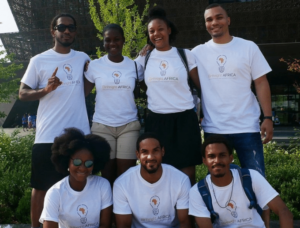
So far, Birthright AFRICA has been able to send 7 lucky students on a trip to Ghana. (Image courtesy of Birthright AFRICA)
Inspired by a program offering trips to Israel for young Americans of Jewish descent, two Black women teamed up to launch a similar program offering a once–in–a–lifetime trip to people of the African diaspora.
Cue the birth of Birthright Africa. The unique program gained its legs after Chicago artist Ashley Johnson heard of the aforementioned Taglit-Birthright program and pondered why there wasn’t a similar one for Black folks, according to The New Yorker. After a few clicks and some googling here and there, Johnson was happy to find such a program — kind of.
Over 10 years ago, a former Goldman Sachs associated named Walla Elsheikh registered a website with the name Birthright Africa after hearing her friend gush about the Taglit trips. Not much ever happened with it, however, until Johnson messaged Elsheikh on Facebook.
The two ladies began talking and eventually decided to launch the program together. Then, in October 2016, the pair traveled to Ghana, and visited all the historically significant sites, from the notorious Cape Coast Castle to the capital city of Accra, the magazine reported.
“Ghana is really seen as the gateway to Africa,” Elsheikh, who grew up in Uganda, Sudan, and Sweden, told The New Yorker. “Birthright Africa is built around the Ghanaian principle of sankofa — in order to know where you’re going, you have to know where you’re from.”
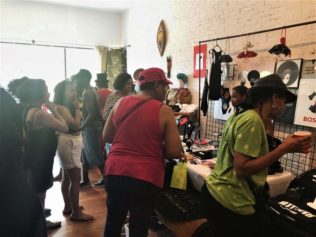
So far, Birthright Africa has financed a trip enabling seven young Black Americans to visit the West African nation. The invitation to travel was extended to all students in the Black Male Initiative program at the City University of New York (CUNY), which supports access to higher ed for students from underrepresented groups. The program helped host a fund-raiser, in part, to benefit Birthright Africa.
“…Birthright AFRICA is working to build a community of organizations owned, managed, or led by people of African descent for our Scholars to explore their cultural roots and discover the innovative contributions made by people of African descent in the U.S. and Africa,” the organization’s website states.
Students aged 18 to 30 were welcomed to apply, and those who made the cut would spend 10 days exploring Ghana — free of charge, according to the magazine. Before jetting off, however, they’d visit the African Burial Ground National Monument in Manhattan, and the National Museum of African American History and Culture, in Washington, D.C.
Devon Simmons, a prospective Birthright Africa applicant at the time and the first-ever graduate of CUNY’s Prison-to-College Pipeline, expressed interest in the program’s international travel opportunities.
” … I just came back from study abroad in Cape Town, doing some research in regards to incarceration over there,” Simmons told The New Yorker. “Next stop is Cuba, this summer.”
Elsheikh, who moved to Ghana last year to help oversee the program’s ground operations, said making the trip helped students to dispel myths and other negative images of Africa. President Donald Trump recently played on these negative tropes, characterizing majority Black countries like Haiti and some nations in Africa as “shithole” countries.
“So it’s that much more relevant to dispel, particularly for people of African descent,” she said. “Because it really hits your soul. We are not pushing a political agenda — but it’s inherently political to educate and empower Black people.”