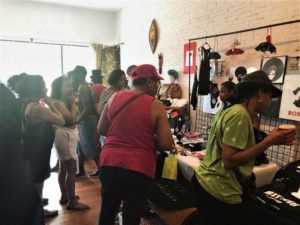
Customers flocked to the recent grand opening of a pop-up market started by Black Market, a Black-owned retail and event space in Boston’s Dudley Square. (Photo /Facebook)
“People! There are ONLY 2 MORE tables available for Saturday, June 24, and then this market will be sold out!” reads a recent Facebook post from Black Market, a new retail space in Boston. “Make sure you get your registration in today and be a part of the Black Market movement!”
Started by Chris and Kai Grant, longtime residents of Boston’s Roxbury neighborhood, Black Market is a business and event space located in Dudley Square, a center of Black life in the city. The couple recently began hosting a regular pop-up market for the public featuring goods and services from many Black small businesses.
The 1,700-square-foot, renovated space at 2136 Washington St. has been a hit so far, attracting swarms of visitors drawn to the vibrant colors and aromas emanating from the tables of vendors, many whom sell African-inspired products, according to Kai.
The weekend grand opening June 10-11 attracted about 1,000 visitors, she told local NPR affiliate station WBUR, and about two dozen vendors who sold artwork, clothing, jewelry, handbags and soaps, much of it reflecting the African diaspora.
Pop-up shops are physical stores used temporarily by retailers. According to Black Enterprise magazine, the stores can be a helpful way to support Black-owned businesses by directly connecting consumers with entrepreneur in their communities.
Kai said she hopes Black Market will generate $250,000 in sales for the vendors it hosts every other weekend, the majority of whom are women. When it is not hosing the pop-up market, the space is available for other events such as art exhibitions and performances.
With the closing last year of A Nubian Notion, a retail store that served the Black community for nearly five decades, there was a need to fill, Kai said.
“We believe in gentrifying our own community,” she told the radio station. “We don’t need a savior.”
“Dudley Square is changing, the demographics are changing. We’re losing a lot of spaces as the rents go up,” vendor and visual artist Cagen Luse of 950Design.com told The Bay State Banner newspaper.
“So it’s great to have a space where artists and entrepreneurs of color can show their work in Dudley.”