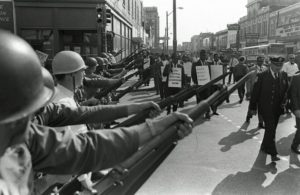
FILE-In this March 29, 1968 file photo, striking Memphis sanitation workers march past Tennessee National Guard troops with fixed bayonets during a 20-block march to City Hall in Memphis, Tenn. Fifty years ago, two sanitation workers were killed by a malfunctioning garbage truck in Memphis. Martin Luther King Jr. came to Memphis to support the strike, a move that cost him his life when he was fatally shot on the balcony of a Memphis hotel on April 4, 1968. (AP Photo/Charlie Kelly, File)
MEMPHIS, Tenn. (AP) — Rain was falling in Memphis, Tennessee, when two sanitation workers picking up trash sought shelter in the back of a city garbage truck on Feb. 1, 1968.
The poorly-maintained truck’s compactor malfunctioned, crushing Echol Cole and Robert Walker to death.
Fed up with bad working conditions, low pay and a lack of benefits, 1,300 black sanitation workers went on strike. Their walk-out drew support from civil rights leader Martin Luther King Jr., who came to Memphis, where he was fatally shot on the balcony of the Lorraine Motel that April 4, the day after he seemingly foretold his own death in his famed “I’ve Been to the Mountaintop” speech at the Mason Temple.
At 1 p.m. EST on Thursday, mayors and elected officials in more than 25 U.S. cities are expected to observe a moment of silence to honor the 50th anniversary of the workers’ death, their pivotal strike and King’s legacy.
Sanitation drivers plan to pull over and people are expected to gather and bow their heads in silence during the demonstration, organized by the “I Am A Man 2018” campaign, which is led by the American Federation of State, County and Municipal Employees; and the Church of God in Christ.
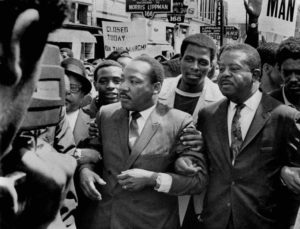
FILE-In this March 28, 1968, file photo, Dr. Martin Luther King Jr. and Rev. Ralph Abernathy, right, lead a march on behalf of striking Memphis, Tennessee., sanitation workers. Fifty years ago, two sanitation workers were killed by a malfunctioning garbage truck in Memphis. Martin Luther King Jr. came to Memphis to support the strike, a move that cost him his life when he was fatally shot on the balcony of a Memphis hotel on April 4, 1968. (Sam Melhorn/The Commercial Appeal via AP)
The moment of silence is one of many events planned ahead of the 50th anniversary of King’s assassination. Since early December, surviving strikers have witnessed the groundbreaking of a new memorial in Memphis near the Clayborn Temple — where organizers passed out the famous “I Am A Man” placards they would carry during protests — and received the NAACP’s Vanguard Award at the Image Awards.
Memphis, Houston, Washington and San Diego, California, are among the cities that will be participating in the demonstration, organizers say.
Washington Mayor Muriel Bowser said the city will honor the lives of Cole and Walker, “celebrating the progress we have made over the past fifty years, and recommitting ourselves to the work still left to do.”
“Today, as we continue fighting for justice and equality, we do so on the shoulders of the many men and women who protested and resisted before us,” Bowser said in a statement given to The Associated Press.
One of those people is Cleophus Smith, a surviving striker. Smith, 75, still works for the Memphis Department of Public Works. He drives a truck and leads a three-man crew, picking up garbage in neighborhoods across the city of about 650,000 people.
Smith was working in a different neighborhood than Cole and Walker and did not know them well, he said in a phone interview Tuesday. Smith and others were told to stay on the job that day.
“We kept working until our job was completed that evening and we went home,” Smith said. “We didn’t have time or any days off.”
On the same rainy day, 22 black sewer workers were sent home without pay while their white supervisors were retained for the day with pay, according to the National Archives.
Workers received little help from their department while toiling in bad weather.
“We didn’t have sufficient equipment to work in, like gloves, shoes, jackets and things like that,” Smith said. “It was a crucial time back then, as far as trying to maintain the job.”
King came to Memphis to march with the workers and gain support for his Poor People’s Campaign. He led a March 28 rally that turned violent when police and marchers clashed.
King promised to lead a second, peaceful march in Memphis, but was killed before he could do so. After weeks of struggling to pay bills and feed their families, the sanitation workers struck a deal for higher pay and improved conditions.
AFSCME President Lee Saunders says the workers “represented the heart of Dr. King’s vision” that labor rights and civil rights are the same.
Smith said he is glad to hear that he and his colleagues are getting recognition. The surviving workers have a busy schedule of events leading up to April 4.
“We haven’t declined anything,” Smith said. “We’re going to continue to work to bring about justice. Just can’t stop here. It’s got to move on.”