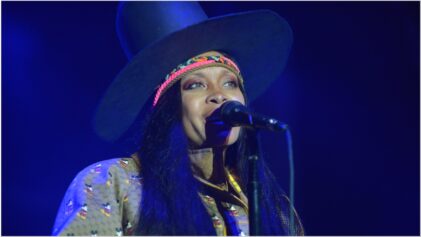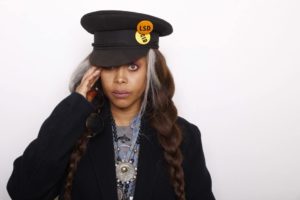
FILE – In this Jan. 25, 2016 file photo, musician and Actress Erykah Badu poses for a portrait to promote the film, “The Land”, during the Sundance Film Festival in Park City, Utah. On Sunday, Badu will host the Soul Train Awards on BET. (Photo by Matt Sayles/Invision/AP, File)
WEST HOLLYWOOD, Calif. (AP) — There’s no question that Erykah Badu is the soul hostess. On Sunday, she’ll host the Soul Train Awards on BET. But earlier this week, she was the soulful host who invited a small group of reporters to a West Hollywood hotel suite for an introductory lesson on chakras.
Badu transformed a room at Le Parc Suite Hotel into an intimate spiritual classroom Monday night for what she described as a “soul therapy” session. Illuminated by candlelight, Badu told her dozen guests about the Eastern concept of chakras — whirling energy centers that stretch from the base of the spine to the crown of the head — and how they respond to music, color and personal development.
Promotional events for awards shows are not usually like this. The show itself was never even mentioned.
Instead, the singer-songwriter engaged the group in a discussion about creativity, opened up about her heroes and revealed that she uses chakra-stimulating sounds in her music. “Baduizm,” her groundbreaking and Grammy-winning 1997 debut, is built around the vibrations of tuning forks and singing bowls, she said. She layered theremin sounds under later recordings.
“I never share any of these kinds of things, that I use tuning forks and singing bowls,” Badu said. “I didn’t know how necessary that was to tell people. And it’s kind of weird to tell people something like that. But we’re entering this age of information where people are more open to this kind of thing… so it’s a good time to share something like this.”
With bells on her ankles, a pile of medallions and crystals around her neck and a stack of colored markers in her hand, Badu explained the seven chakras by diagramming them on a piece of poster board.
Each chakra corresponds with a color of the rainbow, she said, drawing a red circle for the “root chakra” and continuing with spirals in orange, yellow, green, blue, indigo and purple (her favorite color, she noted). Each chakra is also associated with a musical note or vibration, a set of bodily organs and a basic human characteristic, such as creativity, desire or self-discipline, she said.
Badu said she travels with a set of tuning forks, which she pulled from a backpack shaped like an African mask. She clacked one of the forks against a crystal hanging from her neck and held it by each guest’s ear so they could experience its vibration — in the key of F, for the heart chakra.
When the chakra lesson was done, Badu told the group she always considered herself a writer first. She composed her first song at age 7 after her grandmother bought her a piano, and started writing raps and other poetry before becoming a singer.
Asked what song she wishes she had written, Badu said Joni Mitchell’s “Blue.”
“Joni Mitchell is one of my heroes,” she said, adding that they’ve yet to meet. “She’s very responsible for a lot of my honesty and bravery in music.”
Before saying goodnight, Badu offered a last bit of chakra knowledge, explaining how they can be used to interpret body language. Hands on hips, for example, could indicate sexual attraction, since the chakra that governs that energy is based in the lower abdomen.
Such insights help generate compassion for others, she said, and provides a great deal of amusement.
“Once you kind of know these little things and have these little tools, the world becomes a private joke between you and God,” she said. “Some of it just tickles you. But it’s beautiful just how everything connects.”