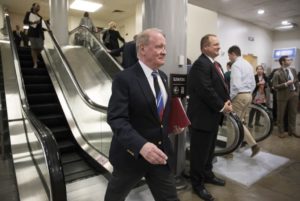
Rep. Leonard Lance, R-N.J., walks through the Capitol after the House passed a budget, with Lance voting nay, (AP Photo/J. Scott Applewhite)
WASHINGTON (AP) — Republicans powered a $4 trillion budget through the House on Thursday by a razor-thin margin, a close vote underscoring the difficulties that lie ahead in delivering President Donald Trump’s promise to cut taxes.
For now, Republicans sidestepped divisions within the party by voting 216-212 to permit them to begin work on a $1.5 trillion tax cut without fear of blocking tactics by Democrats. The legislative landscape is strewn with landmines, however, as GOP tax-writers pick winners and losers among interest groups, business sectors and rank-and-file voters.
The tax bill is the top item on the GOP agenda and would be Trump’s first big win in Congress. Republicans hope it would provide a much-needed jolt for the party’s political fortunes in advance of next year’s midterm elections. Republicans view passage of the upcoming tax measure as a once-in-a-generation opportunity, and its importance has only grown since the party’s debacle on health care.
The goal is a full rewrite of the inefficient, loophole-laden tax code in hopes of lower rates for corporations and other businesses and a burst of economic growth. But evidence is growing that some of their hoped-for bold steps — such as eliminating the deduction for state and local taxes — will be replaced by half-measures dictated by politics and a narrow margin of error.
GOP leaders scrambled in recent days to overcome resistance from House conservatives unhappy about deficits and debt, as well as opposition by lawmakers from high-tax states upset about plans to eliminate the state and local tax deduction. That could mean higher taxes for many middle-class earners, and top Republicans like Speaker Paul Ryan of Wisconsin promise a compromise that won’t be as costly to middle-class taxpayers.
Joining all Democrats in opposing the measure were 20 Republicans, a mix of spending hawks and centrists. More than half come from New York and New Jersey and vehemently reject any effort to roll back the state and local tax deduction.
“This isn’t over,” said Rep. Tom MacArthur, R-N.J., who opposed the budget after voting for it earlier this month. House Speaker Paul Ryan, R-Wis., said concerns by lawmakers such as MacArthur about the deduction would be addressed in coming days, and it was the topic of a post-vote meeting that included top GOP leaders.
“We stood firm … to let them know we’re not kidding,” said Rep. John Katko, R-N.Y., as he exited the session.
The Senate passed the budget measure last week and the House endorsed it without changes, a step designed to allow Republicans to move quickly to the tax measure in hopes of passing it into law this year. House and Senate leaders want to pass companion measures before Thanksgiving with a final compromise coming before year’s end.
Ways and Means Committee Chairman Kevin Brady, R-Texas, said immediately after the vote that he’ll release the tax measure on Nov. 1 and that a panel vote is expected the week of Nov. 6.
That timetable is ambitious as numerous details, including ways to raise revenues to help finance cuts to individual and corporate tax rates, remain unresolved. The tax plan’s popularity is not a given with voters, however, and fissures among Republicans could slow the measure.
A battle over tax-free contributions to retirement accounts has also broken open, and Republican tax-writers have yet to lock down dozens of crucial details on tax rates and preferences. Republicans may also drop efforts to fully repeal taxes on multimillion-dollar estates, even though the idea is a longstanding feature of the party’s tax agenda.
“I’m confident that there will be a tax bill. I’m confident that it will be an improvement over current policy. How good it is yet to be determined,” said former Sen. Phil Gramm, R-Texas, a veteran of Reagan-era tax battles and an architect of a 2001 tax cut. “You always dream of wiping things off the books and making dramatic changes, but it’s very hard to do.”
The underlying budget measure abandons the Republican Party’s promise to rein in deficits in favor of Trump’s boast of “massive tax cuts.” The measure drops proposed cuts to mandatory programs such as food stamps, though conservatives promise to take on spending cuts later.
“I still feel strongly about addressing unsustainable mandatory spending,” said Rep. Diane Black, R-Tenn., who chairs the House Budget Committee. “I think we will tackle this important issue in the future. We don’t have a choice.”
Democrats united against the plan, arguing its tax cuts will pad the bank accounts of the wealthy and the balance sheets of corporations while delivering modest relief — or none at all — to middle-income taxpayers.
“These tax cuts will not create an economic boom, but will instead lead to a higher concentration of wealth among the rich, while dramatically increasing deficits and debt,” said Rep. John Yarmuth, D-Ky.
House Minority Leader Nancy Pelosi, D-Calif., urged Democrats immediately after the vote to “be fully mobilized to expose the ruinous consequences of Republicans’ plans to raise taxes on the middle class, especially as Republicans try to race their bill through the House before the American people can see the damage it will cause in their lives.”
The budget plan calls for $5 trillion in spending cuts over the decade, including cuts to Medicare, Medicaid and the Obama-era health care law, though Republicans have no plans to actually impose those cuts with follow-up legislation. Some Democrats criticized the measure for ruthless spending cuts; others took the opposite approach, failing it for tackling the deficit.


