Khalid Albaih first drew the Colin Kaepernick cartoon in September 2016. (Image courtesy of Al Jazeera)
From avid sports fans to civil rights activists and entertainers, the political cartoon of Colin Kaepernick kneeling with his signature fro in the shape of a big Black fist has been sported by almost everyone.
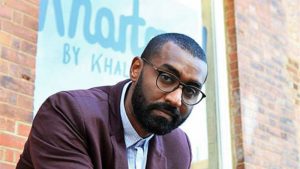
Romanian-born Sudanese artist Khalid Albaih created the now-viral illustration. Acclaimed across the Middle East for his works tackling various social and political issues, Albaih’s new Kaepernick cartoon speaks on a controversy that’s seemingly worlds away from his current home in Qatar: American social justice.
Kaepernick, a former quarterback for the San Francisco 49ers, sparked backlash last year when he refused to stand for the national anthem. Instead, the football player-turned-activist knelt in protest of police violence against African-Americans and other injustices faced by nonwhite people.
Albaih first published the cartoon in September 2016 when he was a human rights fellow teaching at Maine’s Colby College, CNN reported. Through his art, the cartoonist said he wanted to invoke iconic images of Black athletes who took a strong stance against social injustice in the United States.
“The minute I saw [Kaepernick kneeling], it just reminded me of the image of [John] Carlos and [Tommie] Smith with their fists up in the ’68 Olympics,” Albaih said. “It was the ‘Black fist’ of our time. I had to make that connection.”
https://www.instagram.com/p/BKJG7f_gw2x/
Like Carlos and Smith, Kaepernick is paying the price for his controversial protest. It’s been six months since the quarterback became a free agent, and nary an NFL team has snagged him for a spot on a roster for the 2017 season. Suspected blackballing by the league led fans and activists to demonstrate outside NFL headquarters last month.
“People just wanted [Black athletes] to do their sports, clap at them and leave,”Albaih told CNN. “They don’t want them to do anything serious, [or] to be anything but that sports person.”
The cartoonist said he first became interested in the U.S. civil rights movement after he was invited to tour America with his artist collective for a documentary commissioned by The Guardian, CNN reported. Recalling his trek across the nation, Albaih said he realized that whether someone is living in the United States, or Qatar or Syria, “at the end of the day, we’re all just asking for basic human rights, to be considered as people.”
Soon afterward, Atlanta-based clothier Milton “MD” Dodson persuaded Albaih to print the cartoon on T-shirts. The shirts made their way into the hands of celebrities like Chance the Rapper, Snoop Dogg and Dave Chappelle, who have all been seen sporting the cartoon.
Although he saw an early version of the shirts last year, Albaih said he was taken aback when he saw celebrities wearing them.
Although American civil liberties don’t affect him directly, the the renowned artist believes it’s important to address U.S. affairs because “nothing is local anymore. Everything is global.”
“It’s something that people need to understand,” he told CNN. “Everything is connected now. Everybody’s connected now.”