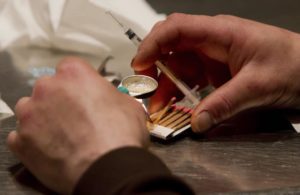
Man prepares heroin he bought on the street to be injected at the Insite safe injection clinic in Vancouver, British Columbia, Canada. (Darryl Dyck/The Canadian Press via AP, File)
NEW YORK (AP) — A safe haven where drug users inject themselves with heroin and other drugs has been quietly operating in the United States for the past three years, a report reveals.
None were known to exist in the U.S. until the disclosure in a medical journal, although several states and cities are pushing to establish these so-called supervised injection sites where users can shoot up under the care of trained staff who can treat an overdose if necessary.
In the report released Tuesday, two researchers said they’ve been evaluating an underground safe place that opened in 2014. As a condition of their research, they didn’t disclose the location of the facility — which is unsanctioned and potentially illegal — or the social service agency running it.
The researchers offered little data, and their main finding was that no one died while injecting at the safe place. There were two overdoses on site, which were reversed by staff members using the overdose medication naloxone.
Advocates and some politicians in recent years have called for government-sanctioned injection sites as the U.S. grapples with the opioid epidemic. More than 52,000 Americans died from drug overdoses in 2015 — the most ever — fueled by soaring abuse of heroin and prescription painkillers. Government statistics for the first nine months of last year, also released Tuesday, show overdose death rates continuing to spiral.
Some say the new report could have an impact on efforts to establish safe injection sites around the U.S. Such sites have been backed by lawmakers in New York, California and other states, along with officials in cities like Seattle, San Francisco and Ithaca, N.Y.
“It shows people that it’s possible” to operate one of these in the U.S., said Lindsay LaSalle, an attorney with Drug Policy Alliance who has helped draft safe haven legislative proposals in six states.
Injection sites are legal in countries including Australia, Canada, Denmark, France, Germany, Luxembourg, the Netherlands, Norway, Spain and Switzerland where medical professionals monitor drug users. They also provide clean needles to prevent the spread of infectious diseases like HIV or hepatitis C. Ideally, they also steer users into treatment and other services.
Some experts say new approaches are needed to fight the opioid epidemic, including safe havens. But they’ve faced legal and political hurdles. Critics have argued these places may undermine prevention and treatment, and seem to fly in the face of laws aimed at stopping use of deadly illicit drugs.
Safe injection sites are different from syringe exchange programs, which were once controversial but now exist in 33 states.
The underground safe haven is open between four and six hours a day, five days a week, according to Alex Kral, a San Francisco-based researcher with RTI International, and Peter Davidson of the University of California, San Diego. Their report was published online in the American Journal of Preventive Medicine.
The space consists of two rooms — an “injection room” with five stainless steel stations with mirrors and stools and a room next door where users are monitored afterward. There are trained staff on hand, but no one who is medically licensed, according to the researchers. Smoking is not allowed there, but drugs like heroin, pain pills, cocaine and methamphetamine are.
Use of the space was by invitation only. Most visitors are white, homeless men. It was used 2,500 times over two years by over 100 people, although researchers say the exact number of participants isn’t known because the facility relies on anonymous surveys.
There’s no data on deaths or drug use by clients who injected when the site was closed and it’s not known whether any went into treatment, Kral said.
The study also didn’t look at issues opponents worry about, like whether creation of a safe place is associated with an increase in people beginning to try drugs, said Jonathan Caulkins, a drug policy expert at Carnegie Mellon University who nonetheless applauded the organization’s effort to try to stop overdose deaths.