 Malik Wade stood waiting for a strange car to pull into the damp alleyway. The air was cold and brittle against his face. A black duffel bag hung from his nervously clenched fist. The bag was full of crack cocaine awaiting drop-off to a man in a blue SUV. Wade anxiously hugged his coat and looked over his shoulder. It had become force of habit since he began life on the run from the FBI. He was 28 years old.
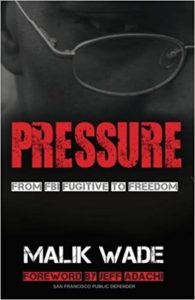
Now in his early 40s, Wade is an accomplished entrepreneur, thinker, mentor, advocate, lecture and author. In his newly published autobiography, “Pressure: From FBI Fugitive to Freedom,” he details his journey from well-connected drug dealer to FBI fugitive to prison inmate to respected community leader in his native San Francisco.
Wade writes with an honesty and courage that sheds light on the disparities of Black inner-city life during the rise of the crack era in the ’80s, the subsequent escalation of FBI surveillance and the conditions of the prison industrial complex.
“I was very hesitant to share this story because I felt it was kind of cliché. But [upon] getting deeper into writing this book, I realized that I could use my story to educate,” Wade said.
While growing up in the neighborhoods of San Francisco’s inner city, Wade had already been struggling with adversity. He grew up during the crack cocaine epidemic of the 1980s, where crack levels skyrocketed in the Black community, often attributed to a CIA-backed conspiracy. Wade originally dreamed of being an athlete, but the pressure of being raised by a single mother of three in the projects would push him over the edge and into a life in the streets.
Wade got his start drug dealing as a 16-year-old in the Sunnydale housing project. A year later, he was busted and sent to a juvenile detention facility. At 18, he was released and returned to the drug trade. By age 19, Wade controlled a network that stretched from the San Francisco Bay Area to Washington, D.C., New York and Pittsburgh, Pa.
When Wade was 22, he was investigated by the FBI and appeared on their wanted list. He spent seven years on the run from the law, but at age 29, he was apprehended and incarcerated.
While in the belly of the prison industrial complex, Wade made a commitment to himself and his community to transform his life. He began a disciplined program of self-education and self-development.
“I knew that the prison would not be responsible for my rehabilitation. I knew that my rehabilitation would come solely from within,” Wade said. “From day one, I got involved with pretty much every type of education program that I could. I read a lot and developed a very strict regimen of studying for a minimum of 10 hours a day.”
Wade served 14 years of his 15-year sentence and once released, he enrolled in a Stanford Law School program for formally incarcerated students called Project ReMADE, where he developed his entrepreneurial skills. He graduated from the program in 2013 and was invited to speak as a guest lecturer at UC-Berkeley and San Francisco State University.
In 2013, Wade started a nonprofit called Scholastic Interest Group (SIG). Born out of his adolescent dream to be an athlete, SIG works with Black men, many of whom are athletes, and aids them in personal development, mentorship, job-training and college readiness.
“Scholastic Interest was a nonprofit organization I founded right out of prison,” Wade said. “One of the biggest components of the program is feeding young men and providing them with opportunities for jobs.
“We were able to reach 90 percent of the young men from ages 12 to 13.”
Once a week, Wade meets personally with the young men of the program, checks in with them on their home life and their progress in school, and takes them out to eat a healthy meal. SIG organizes regular trips to college campuses and community service initiatives in the San Francisco area. He has even taken the students on a trip to Ghana for an educational exchange.
Wade’s autobiographical account of his life story has been two years in the making. Like a diamond made from coal, it is the pressure of his life struggle and imprisonment that produced the transformative community leader that Malik Wade is today. But the book is not just his own story. It’s also a searing personal commentary on the effects of racism, poverty and mass incarceration on the Black community in general.
“It is a story that I wrote to educate and enlighten people who may not be familiar with the struggles of what a Black man goes through in the inner city,” Wade said. “The current situation is dire, as we know. We must be very mindful and continue to educate ourselves on the agenda. We must continue to organize and mobilize.
“It is very important that we continue to offset the things that are affecting the community particularly the laws and legislation.”
“Pressure” was released on June 15 and is available for sale online at Amazon, Barnes and Noble and at MalikWade.info. For more information on the book and the author, please visit MalikWade.info.