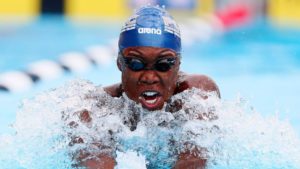
Reece Whitley is currently seeded eighth in the 200 breaststroke, ninth in the 50 and 11th in the 100 at the U.S. nationals. (Image courtesy of ABC News).
Standing 6 feet, 9 inches tall at just 17 years old, elite-level swimmer Reece Whitley is shaping up to be the next famous face of U.S. Olympic swimming. Whitley’s surge to the top has been spectacular since he dove into swimming full time, but the question remains if the majority-white sport is ready for an African-American swimmer capable of blowing the competition out the water.
For the Pennsylvania native, the notion of a Black swimmer will hopefully one day become the norm rather than a novelty. The world of swimming still has a ways to go, however, as success for elite Black swimmers in the U.S. only recently started with 2008 Olympic gold medalist Cullen Jones and ended with newcomer Simone Manuel, who also snagged a gold at the Olympic games in Rio de Janerio last year, The Washington Post reported.
That’s not to say that the sport hasn’t made any progress, though; Jones became the first African-American to hold a world record in swimming, while Manuel joined fellow swimmers Lia Neal and Natalie Hinds in becoming the first African-Americans to take the top three spots in a single event (100 freestyle) at the Women’s Division I NCAA Championships in 2015.
While racial advances in swimming have been especially slow, Whitley’s arrival on the scene is a sign for future progress in the sport.
“If he was just another white, 6-7 breaststroker, we wouldn’t be having this conversation,” swimming analyst Rowdy Gaines told The Washington Post in a recent interview. “That is why Reece is so important: what he can do for this sport, how he can promote it in a way no one has.”
“The only stumbling block? He has to win,” Gaines added. “I know that’s obvious, but it’s the most important step, the biggest next step he has to take. He has to win.”
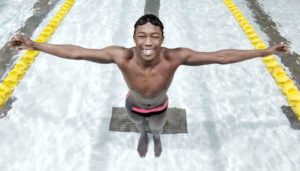 The newspaper reported that Whitley, who committed to the University of California just two weeks ago, arrived at U.S. nationals this week seeded eighth in the 200 breaststroke, ninth in the 50 and 11th in the 100. He spent the entirety of high school swimming for the Penn Charter Aquatic Club in Philadelphia under coach Crystal Keelan, who helped mold him into the competitive swimmer he is today, according to Swim Swam.
Whitley has been breaking age-group records since he was 13 and now reigns as the national age-group record holder for 15- and 16-year-old competitors in the 200-meter breaststroke, The Washington Post reported. Gaines noted that Whitley’s competitive spirit, coupled with his skin color, will perhaps make him the most influential male swimmer since Michael Phelps — the most decorated Olympian of all time. The teenager is slated to snag a spot at the FINA World Junior Nationals coming up in August.
“I was driven to prove to myself and to others that I was good — really, really good,” Whitley told The Washington Post, adding that he’s accustomed to being “the only one.”
“This week, I want to swim as fast as I can. But if I walk away and I’m not on a team this summer, but I swam my best times, yeah, I’ll be disappointed I won’t be able to wear the American flag on my cap, but I want best times,” he added. “That’s what matters.”
The teen swimmer sort of separated himself from the very few other Black students in his classes growing up when he opted to hop in the water, placing enormous pressure on him to succeed and enact change within the sport. Due to historic racial and economic barriers to recreational swimming pools, recent research from the USA Swimming Foundation and the University of Memphis found that nearly 70 percent of African-Americans do not know how to swim. Because of this, Whitley said he understands the impact of his race in diversifying the sport and doesn’t shy away from questions on the topic.
“Right now, it’s a relevant question, so I don’t take any shame in answering it,” he told the Washington Post.
“At the end of my career, if I look back on it and that question is irrelevant, then that means I would have fulfilled my goals.”