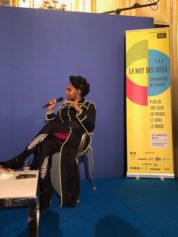
Chimamanda Ngozi Adichie appeared at a D.C. event to promote her book on how to raise a feminist daughter. (Chimamanda Ngozi Adichie Facebook)
Unwilling to back away from her idea that trans women don’t share the same experience as women born female, Chimamanda Ngozi Adichie refuses to apologize for causing so much controversy in the first place.
“From the very beginning, I think it’s been quite clear that there’s no way I could possibly say that trans women are not women,” Adichie said at a Monday, March 20, event organized by Washington, D.C., bookstore Politics & Prose, according to The Guardian. “Of course they are women, but in talking about feminism and gender and all of that, it’s important for us to acknowledge the differences in [the] experience of gender. That’s really what my point is.”
Adichie, a Nigerian feminist writer, faced pushback from critics after she told Channel 4 News, “My feeling is trans women are trans women,” Monday, March 10. Two days later, she clarified those statements on Facebook writing, “Perhaps, I should have said trans women are trans women and cis women are cis women and all are women.”
At Politics & Prose promoting her book, “Dear Ijeawele, or A Feminist Manifesto in Fifteen Suggestions,” Adichie stated, “I didn’t apologize because I don’t think I have anything to apologize for,” she said.
“What’s interesting to me is this is in many ways about language and I think it also illustrates the less pleasant aspects of the American left, that there sometimes is a kind of language orthodoxy that you’re supposed to participate in, and when you don’t, there’s a kind of backlash that gets very personal and very hostile. …
“Had I said, ‘A cis woman is a cis woman, and a trans woman is a trans woman,’ I don’t think I would get all the crap that I’m getting, but that’s actually really what I was saying.”
Adichie also doubled down on her idea that gender is about an individual’s interactions with the world, harkening back to her statement that a woman who once lived as a man has felt male privilege.
“I think gender is about what we experience, gender is about how the world treats us, and I think a lot of the outrage and anger comes from the idea that in order to be inclusive, we sometimes have to deny difference,” she said. “I think that because human difference for so long, in all its various forms, has been the root of so much oppression, sometimes there’s the impulse to say, ‘Let’s deny the difference,’ as though by wishing away the difference, we can then wish away the oppression.”
Adichie also cleared up any misconceptions about why she thinks acknowledging differences among all women is necessary.
“I think there were people who felt I was somehow making a point about the Oppression Olympics: You haven’t suffered enough,” she said. “It’s not at all that. It’s simply to see that if we can acknowledge there are differences, then we can better honestly talk about things.”