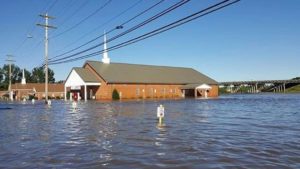
Several Princeville families were barred from entering their homes after Hurricane Matthew due to the extensive damage. Photo by WTVD.
After two devastating floods, officials of a historic African-American town in North Carolina say the community still hasn’t received the aid it needs to rebuild from either the state or federal governments.
The tiny town of Princeville, N.C., the oldest town incorporated by Black Americans in the country, was ravaged by Hurricane Floyd in September 1999 and Hurricane Matthew in October 2016, despite a levee that was supposed to protect the town from floods, The News & Observer reported. The town was able to rebuild after Floyd and residents slowly returned. However, it’s been a struggle to get the community the help it needs following the significant damage caused by Hurricane Matthew.
“We need trailers on the ground,” town manager Daniel Gerald told the paper Friday, March 10. “We need immediate housing now. Not tomorrow. We need it now.”
After Matthew wreaked havoc on Princeville, Gerald said 241 of the community’s 750 single-family homes had major damage. Damaged less severely but still unlivable were 229 other homes. Residents forced to evacuate in the midst of the storm were barred from their homes for two weeks or more as the floodwaters ravaged furniture, appliances and a host of other personal possessions.
The town manager said temporary housing was built for residents following Floyd, but today, federal officials are declining to place mobile units in the community due to the flood threat. Flood maps from the Federal Emergency Management Agency previously showed that Princeville was in a Zone X, meaning that the levee would protect it from flood waters, The News & Observer reported. However, the agency’s post-Matthew maps placed the town in Zone AE — a 100-year flood zone that indicates the community has a 1 percent chance of flooding in any given year, according to the newspaper.
Because Princeville is now located in flood-prone area, stringent state and federal guidelines prevent FEMA from placing temporary housing there, agency spokesman Mike Wade said.
“It’s not that we don’t want to,” Wade explained. “It’s just that we can’t.”
To remedy the housing issue, FEMA has relocated Hurricane Matthew victims to 29 units in the nearby town of Tarboro, located just 10 miles from Princeville, Wade told Atlanta Black Star via email. Not every unit is allocated for residents of Princeville but for the County of Edgecombe, he said. Fifty-two families are still being housed in hotels.
“While homes are being repaired, FEMA has provided eligible survivors rental assistance which pays for rent on a temporary basis until their home is repaired,” Wade explained. “If there are no rental properties available a survivor may to eligible for our Transitional
The historic town, located in North Carolina’s Edgecombe County, was incorporated in 1885 after the end of the Civil War when emancipated Blacks stayed behind at former union troop encampments and settled in an area known as Freedom Hill, according to the town website. The community was later renamed Princeville in honor of Turner Prince, a formerly enslaved man who established the community 20 years prior by building some of the town’s first homes. Whites at the time did not protest the creation of the settlement because it was on land that they did not want to settle because, even at that time, the area was known to have flooding issues.