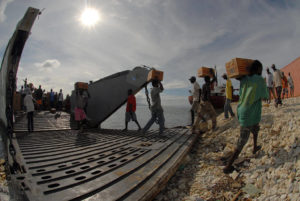
Haitians offload disaster relief products from a landing craft after hurricanes. A deal with the UN looks to provide more effective relief (Wikimedia Commons)
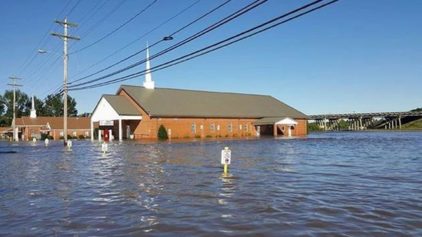
NEW YORK — The United Nations together with relief organizations in Haiti have launched a two-year, $291-million response plan with the government to reach more than 2.4 million people across the island that was struck by a devastating hurricane last October.
“With more than 98 percent of Haitians exposed to two or more types of disasters, and over half of its population living in poverty, Hurricane Matthew has once more demonstrated Haiti’s weakened ability to cope, recover and adapt to shocks from natural disasters,” noted Mourad Wahba, the Humanitarian Coordinator for Haiti, in the plan’s foreword.
The two-year Haiti Humanitarian Response Plan, launched on Monday, is built on lessons learned so the island can transition from a relief-focused type of operation – like one that follows a disaster like an earthquake – to a longer-term development approach in fragile countries. It should be seen as a convergence process rather than sequential since the humanitarian and development needs occur simultaneously.
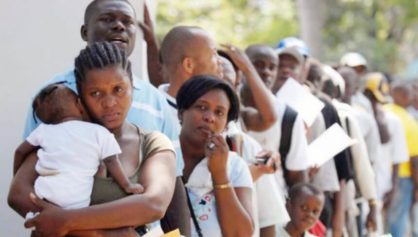
According to estimates undertaken by the Humanitarian Country Team, some 2.7 million Haitians will require humanitarian, protection or early recovery assistance in 2017, of which 2.4 million will be targeted countrywide. The October hurricane severely exacerbated pre-existing humanitarian, socio-economic and environmental vulnerabilities and disparities.
Under the plan, humanitarian interventions with a focus on improving access to lifesaving services to those affected by Hurricane Matthew, cholera, and other diseases, as well as on protecting the most vulnerable will be scaled up.
At the same time, actions to promote resilience and access to durable solutions will be implemented, targeting those displaced due to the 2010 earthquake, Hurricane Matthew, as well as those repatriated or voluntarily returned from neighboring Dominican Republic.
Read more here.