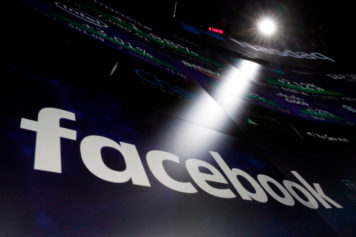
Snap Inc.’s market capitalization was set at $33 billion, surpassing Twitter’s market cap of $11 billion. Photo by Richard Drew/AP Photo.
Snap Inc., the tech company that gave us popular disappearing messaging app Snapchat, became a publicly traded company on Thursday, March 2, blasting its 20-something-year-old co-founders to the upper echelons of tech billionaires.
Soon after Snap co-founders Evan Spiegel, 26, and Bobby Murphy, 28, rang the opening bell of the New York Stock Exchange, the company’s share price skyrocketed 41 percent from its guide price of $17 a share to an opening price of $24, The Guardian reported. Minutes later, the share price rose to $25 and is expected to reach even higher.
Snapchat, which has grown in popularity among teens and young adults over the past few years, is slated to rival social media giant Facebook, whose platform dominates the social media and advertising space. Snapchat reports that nearly 158 million people interact on its service each day, creating and sending 2.5 billion “snaps” between them.
Although their user numbers are much lower than Facebook’s, which sees a billion-plus users daily, the app draws a young user base, with “snapchatters” spending close to 30 minutes on the service each day. Facebook founder and CEO Mark Zuckerberg seemingly noticed Snap’s potential for success, as he offered to buy the tech company for $3 billion in 2013. Luckily, Spiegel and Murphy declined, as their decision to go public has earned them a paper fortune worth more than what Zuckerberg was offering.
The company’s opening price of $24 a share placed its market capitalization at around $33 billion, which is near the size of companies like Marriott and Target, according to CNBC. Its market cap is now higher than fellow popular social media company Twitter, whose market capitalization sits at just $11 billion. Facebook surpasses both companies with a market cap of $395 billion.
The sale of Snap, which Spiegel calls a “camera company,” is the largest since Chinese e-commerce company Alibaba’s IPO in 2014, The Guardian reported.
It hasn’t always been smiles and sunshine for Snap Inc., however. Last year, the company posted a $515-million loss, leaving its co-founders doubting their ability to “achieve or maintain profitability” as Spiegel and Murphy continued investing heavily in their business.
“We began commercial operations in 2011 and for all of our history, we have experienced net losses and negative cash flows from operations,” Snap said in its regulatory filing with the SEC in early February. “If our revenue does not grow at a greater rate than our expenses, we will not be able to achieve and maintain profitability.”
Despite its huge losses, investors still saw the potential for rapid growth in the California-based company stuck with it. Now, they hope it will push other successful start-ups, like Uber and Airbnb, to consider entering the world of public trading.
It’s probably safe to say Thursday’s IPO paid off for the young tech entrepreneurs, with Spiegel and Murphy pocketing close to $5 billion each. Before their public offer, Spiegel was ranked No. 854 on “Forbes’ 400” list of the richest people in America (2016), touting a net worth of $2.1 billion, while Murphy’s net worth was listed at $1.8 billion on that same list.