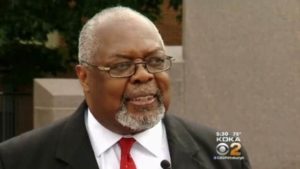
Former Pittsburgh Councilman and Freedom Rider Sala Udin. Photo courtesy of CBS News Pittsburgh.
As part of a last-minute clemency push ahead of the Christmas holiday, President Obama on Monday, Dec. 19, granted 78 pardons — the most in his presidency — and another 153 commutations to federal inmates and former offenders who had been locked up and handed unduly harsh prison sentences.
Udin, 73, was one of those individuals.
The former councilman worked as a Freedom Rider in 1960s Mississippi and recalled being beaten up and taunted by white police officers as he tried to register Black voters down South. But there was one criminal charge from Udin’s activist past that he just couldn’t seem to shake: a conviction for carrying a firearm across state lines.
The young activist was stopped for speeding one night as he drove fellow protesters home and was subsequently arrested when officers discovered an unloaded shotgun and a jug of moonshine in his vehicle, according to Yahoo News. Udin was charged and convicted in 1972, spending eight long months in jail.
Udin eventually went on to found an African-American culture center and the New Horizons Theater in Pittsburgh and also served three terms on the Pittsburgh City Council (1995-2006), playing a vital role in the creation of the city’s police civilian review board.
Udin has never denied his guilt, but he did provide some context for his actions.
“At that point, although I was previously committed to nonviolence, I concluded that if I was trapped on some lonely, dark road in the South and confronted by Klansmen who threatened to kill me, I would be prepared to defend my life,” Udin wrote four years ago in his pardon petition to the U.S. Justice Department. “I concluded that I would rather be caught by the police with defensive weapons than to be caught by the Klan without them.”
Last week, Udin got word that the president planned to grant a few more pardons ahead of the Christmas season but said he didn’t want to get his hopes since he had never gotten a response to his clemency request. That is, until he got a call on Monday.
“I’m ecstatic,” Udin told Yahoo News. “My wife and I just hugged and thanked God. It’s a burden relieved from decades of carrying around the tagline, ‘convicted felon. Now they have to add, ‘PARDONED ex-felon.'”
Udin is finally getting what White House Counsel to the President Neil Eggleston described as President Obama’s belief that “America is a nation of second chances.” In the past eight years, the outgoing POTUS has granted approximately 1,176 second chances to former offenders and federal inmates across the nation.
Udin said he was happy to be lucky enough to get a presidential pardon.
“It’s a second chance, and I think, for most crimes, people deserve a second chance,” he told his hometown newspaper, the Pittsburgh Post-Gazette. “Some of them would mess up again, but most of them would take full advantage of a second chance.”
“I’m still pinching myself because this has been such a long time,” he said. “I just needed that last acknowledgement from someone that that bad time in my life is over.”