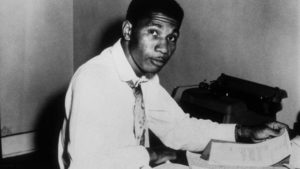
Civil rights activist Medgar Evers circa 1960 in Jackson, Mississippi.
Slain civil rights activist Medgar Evers was nominated to receive the Presidential Medal of Freedom by Mississippi’s congressional delegation Friday, The Clarion-Ledger reports.
Evers, a fighter for social justice and racial equality, was assassinated outside his home in Jackson, Mississippi on June 12, 1963 shortly after President John F. Kennedy gave his first civil rights address to America. His dedication and work in promoting social justice for all is ultimately what moved the delegation to nominate him for the high honor.
“Mr. Evers dedicated his life to the defense of civil rights in Mississippi and the United States,” U.S. Sens. Thad Cochran and Roger Wicker and Reps. Bennie G. Thompson, Gregg Harper, Steven Palazzo and Trent Kelly wrote in a letter to President Barack Obama. “… His leadership, dedication and sacrifice continue to inspire many Americans and have enhanced freedom for all of humankind.”
Evers’ widow, Myrlie Evers-Williams, expressed great joy upon hearing the news that her late husband was being nominated for such a prestigious award.
“My heart is racing,” she said. “I’m so thankful the Mississippi delegation has acted on this, and it is my hope the president will approve and that Medgar will be honored in this way. He truly deserves it.”
Reena Evers-Everette, daughter of the late civil rights leader, also expressed gratitude to those wishing to nominate her father. According to The Clarion-Ledger, Evers-Everette now serves as the executive director for the Medgar and Myrlie Evers Institute.
“[My father] believed in and fought for his country, first on the beaches of Normandy and then when he returned home and fought racism and prejudice in the land he loved, Mississippi,” she said. “He was a man who wanted greatness for all of humanity.”
In 1954, Evers applied at the University of Mississippi School of Law only to be turned down because he was Black. He went on to become the first field secretary for Mississippi’s NAACP, mobilizing volunteers, leading marches and organizing voter registration drives. The activist was ultimately shot and killed for his social justice efforts.
Per The Clarion-Ledger, the Presidential Medal of Freedom is the highest U.S. civilian honor awarded to those who have made “an especially meritorious contribution to the security or national interests of the United States, world peace, cultural or other significant public or private endeavors.” Other Mississippi natives who have received the high honor include civil rights activist James Earl Chaney (2014), blues musician B.B. King (2006) and media mogul Oprah Winfrey (2013).
Evers was also posthumously awarded the NAACP Spingarn Medal for outstanding achievement in 1963 and is featured in the new Smithsonian National Museum of African American History and Culture in Washington, D.C.