Civil rights champion and longtime Democratic congressman John Lewis has died at the age of 80. Lewis, who had been battling pancreatic cancer since late 2019, passed away in Atlanta on Friday night.
Lewis was a giant of the civil rights movement, and in the modern era he continued to pursue racial justice until the time of his death. He recently led a virtual town hall alongside President Obama to mentor young activists who were leading protests following the death of George Floyd.
Born in Alabama in 1940, Lewis was the son of sharecroppers and experienced the horrors of Jim Crow in the South. Lewis began working to challenge racial segregation by participating in workshops on nonviolent confrontation as a 19-year-old college student in Nashville, Tennessee, in 1959. Lewis would go on to take part in sit-ins and demonstrations and, through his fearlessness and dedication to the cause, rise quickly in prominence in the movement. By 1961, he became one of the original participants in the Freedom Rides, the act of Black activists taking interstate bus rides to challenge the illegal but persistent practice of segregation along the routes in the South.
Often beaten and arrested as he faced segregationists head-on, his dedication to fighting white supremacy led him to become a founding member of the Student Nonviolent Coordinating Committee in 1963 (SNCC). That same year, Lewis went on to be one of the “Big Six” leaders of groups who organized the historic March on Washington. He was the last living speaker from the march.
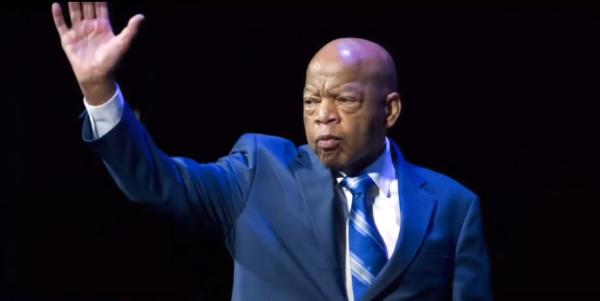
In 1965, Lewis was a prominent figure of the voting rights campaign and worked beside other civil rights leaders in Selma, Alabama. On Bloody Sunday, March 7, 1965, Lewis was among the hundreds of activists brutally attacked by state troopers as they marched across the Edmund Pettus Bridge. The group was setting out to march the 54 miles from Selma to the state capital of Montgomery to protest the recent police shooting of a 26-year-old activist who was killed when trying to protect his mother from being clubbed. Lewis suffered a concussion and fractured skull on that violent Sunday in an encounter that was captured by news cameras and broadcast to a shocked nation.
Lewis graduated from American Baptist College and from Fisk University, and holds more than 50 honorary degrees from prestigious HBCUs and Ivy League colleges. He entered Congress in 1987, and was serving his 17th term as a representative of Georgia’s Atlanta-area 5th District at the time of his death.
On Friday, President Obama made a statement about his relationship with the man who became known as the “conscience of the Congress,” saying: “I first met John when I was in law school, and I told him then that he was one of my heroes. Years later, when I was elected a US senator, I told him that I stood on his shoulders. When I was elected president of the United States, I hugged him on the inauguration stand before I was sworn in and told him I was only there because of the sacrifices he made.”
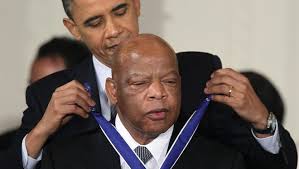
During the civil rights era, Lewis was arrested 40 times. In 2011, President Obama awarded him the Presidential Medal of Freedom, the highest civilian award bestowed by the U.S. Lewis, often described as “one of the most courageous persons the civil rights movement ever produced,” is survived by his only son, John Miles Lewis.