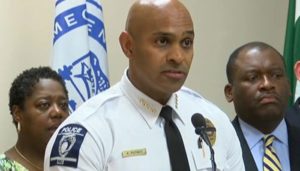
Charlotte-Mecklenburg Police Chief Kerr Putney (Source: WBTV News)
Now that Keith Scott’s family has had the chance to review police footage of their loved one’s final moments, relatives say now is the time for the public to see the videos too.
But according to the Daily Beast, time is running out for Charlotte-Mecklenburg police to release the tapes, as a new law sealing off police footage is set take effect in just seven days.
Scott, 43, was shot and killed by police Tuesday afternoon after authorities say he was armed with a gun and refused to drop his weapon. The slain man’s family asserts that he only had a book, not gun, and was in his car reading while he waited for a family member to return home from school. Police reportedly recovered a gun at the scene.
Scott’s relatives, protesters and even Charlotte Mayor Jennifer Roberts have called on police chief Kerr Putney to release dashcam and bodaycam footage from the deadly shooting. Demonstrators, who have taken to the streets for three nights in a row now, have vowed to continue protesting until Putney releases the tapes. The police chief has held fast in his decision to withhold the footage until the rioting and protests die down.
It’s hoped that Putney has a change of heart — and fast — because on October 1, a new law will seal off the footage as private personnel record.
According to the Daily Beast, HB 972 was signed into law by Republican governor Pat McCrory and essentially changes the classification of bodycam and dashcam footage from public record to personnel record. This means that law enforcement officials will now have to get approval from a judge in order to release such video.
The legislation states that in determining whether all, or portions, of police footage should be released to the public, the benefit(s) of doing so must meet at least one of the following standards: “release is necessary to advance a compelling public interest”; “the recording contains information that is otherwise confidential or exempt from disclosure or release under State or federal law”; and “release would create a serious threat to the fair, impartial, and orderly administration of justice,” among other criteria.
But until October 1 rolls around, its up to police chief Putney to make the call.
“We release it when we believe there is a compelling reason,” Putney said at a news conference.
Despite the police chief dragging his feet, activists and community leaders have continued to push for transparency on the part of law enforcement.
“As far as we’re concerned CMPD should release this video,” said Mike Meno, a spokesman for ACLU-Charlotte. “They can and they and they should release it today.”
Meno went on to assert that HB 972 would only make it harder for future videos of police shootings to be released.
According to the Daily Beast, three police chiefs have since spoken out against the law, asserting that individual police agencies should be left with the decision on whether to release police footage.
“This gives me no leeway to manage public perception, and that’s probably not a good thing,” Burlington police chief Jeffrey Smythe told the Burlington Times-News. “So I’m a little disappointed that that avenue isn’t there, except by court order.”
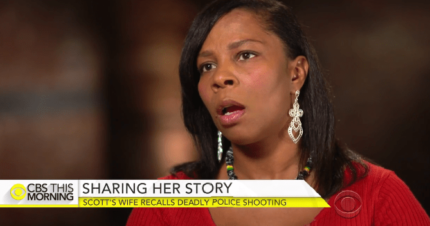
While the country waits for Putney release video of the deadly incident, newly released cellphone footage from Scott’s wife, Rakeyia Scott, offers people a glimpse into the police chaos that left her husband dead.
In the short video, Scott can be heard begging police not to shoot her husband. A firestorm of bullets is heard shortly thereafter.