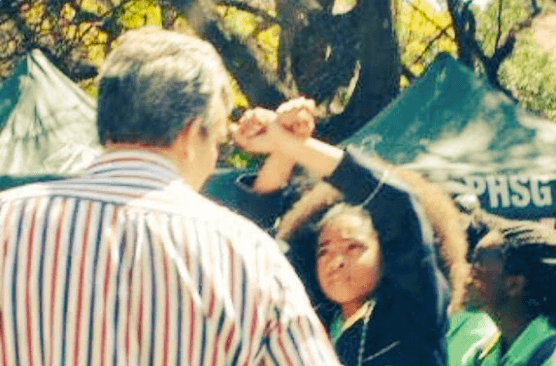
A student protests at Pretoria Girls High School in South Africa. (Twitter)
Students at Pretoria Girls High School in South Africa staged a protest Aug. 26 to fight school rules banning their natural hair. The hashtag #StopRacismAtPretoriaGirlsHigh picked up steam Sunday after video of a teacher attempting to snatch a student’s phone circulated on Twitter.
https://twitter.com/uaubfremh/status/769981392839114752
Students chanted “we are tired” in protest. They believe their school policies aim to discourage traditional Black hair styles like Bantu knots and braids, according to eNCA.com.
"We are tired" #PretoriaGirlsHigh pic.twitter.com/Sz8NxLLTUK
— African Child (@ZikhonaTshona) August 29, 2016
Though youth made up the majority of protestors, the government brought out the Hi-Risk Unit and police dogs to counter them.
https://twitter.com/themii79/status/769975650744762368
A petition launched to overturn the racist hair policies states staff forced some students to straighten their curls.
“It is unacceptable that in a country in which Black people are a demographic majority, we still today continue to be expected to pander to whiteness and to have it enforced through school policy,” it continued.
It currently has more than 18,000 signatures of a 20,000 goal.
According to the school’s dress code, braids, cornrows and dreads cannot be more than 10 millimeters in diameter. Cornrows must go straight back. And no “eccentric” styles are permitted.
As a result, one South African called reports of students being forced to relax their natural hair “absurd.”
Being forced to relax your hair in 2016 is absurd. White schools still cant see the beauty in an Afro. Tsek! #StopRacismAtPretoriaGirlsHigh
— #uTatakho (@ItsYangaChief) August 28, 2016
On top of a ban on natural Black hair, students say they cannot use their home languages at school.
School rules forbid us from speaking our home languages during school hours. 'No foreign languages' it read. #StopRacismAtPretoriaGirlsHigh
— Yelwa (@_Yelwa) August 28, 2016
@MissLopi revealed teachers also criticized students for being “too loud” and said they “have no manners.”
We were told we're too loud, have no manners, we weren't allowed to speak our own language, its rude #StopRacismAtPretoriaGirlsHigh
— Miss Lopi (@HerSlayship) August 28, 2016
Today, Gauteng province’s Education Member of the Executive Council Panyaza Lesufi visited the school. He is responding to claims of racist policies at Pretoria.
MEC Panyaza Lesufi has arrived at #PretoriaGirlsHigh pic.twitter.com/JzQHnIaUfF
— African Child (@ZikhonaTshona) August 29, 2016
Lesufi told Cape Talk students informed him of some especially racist practices teachers use to discourage natural hair.
“They believe the policy is really insensitive to their natural hair. They are told to straighten their hair and that their hair looks like bird’s nest,” he said. “There are other teachers and learners who carry a comb. When they see a black learner they would throw the comb at the learner and say go to the bathroom to comb your hair,” he said.
Since the rally began, it has gained coverage and support around the globe.
Lé Cocoapuff expressed the importance of natural hair in this tweet.
https://twitter.com/RespectTheAfro_/status/770138911641374720
@Miss_LIRA told the girls to “wear your crown with pride.”
No African child needs permission to be who she is! Wear your crown with pride!! Nxa #StopRacismAtPretoriaGirlsHigh pic.twitter.com/15QipzSt7O
— First African Barbie Role Model🌺 (@Miss_LIRA) August 29, 2016
And South Africans not connected to the school also shared their support.
https://twitter.com/chiefntshingila/status/770131958991028224?