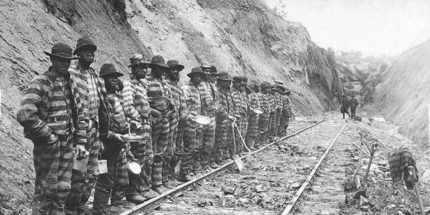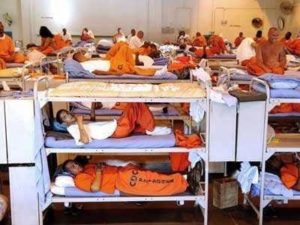
Image courtesy of Business Insider.
The Department of Justice announced plans to end its use of private prisons Thursday, citing the major safety and security issues that occur at privately operated facilities.
According to the Washington Post, Deputy Attorney General Sally Yates made the announcement in a memo Thursday telling officials to cease the renewal of contracts with privatized prisons. Officials also have the option to “substantially reduce” the scope of said contracts, the paper reports.
For Yates, the ultimate goal is “reducing — and ultimately ending — our use of privately operated prisons.”
“They simply do not provide the same level of correctional services, programs, and resources; they do not save substantially on costs,” she wrote in the memo. “And as noted in a recent report by the Department’s Office of Inspector General, they do not maintain the same level of safety and security.”
Last week, the Inspector General’s office released a scathing review of the nation’s privatized prisons. According to its report, officials found that “contract prisons incurred more safety and security incidents per capita” than did facilities run by the Federal Bureau of Prisons. For instance, the private prisons were reported as having eight times the cell phone contraband confiscated on an annual basis than BOP institutions. The contract facilities also had higher rates of both inmate-on-inmate and inmate-on-staff assaults, according to the review.
“…Consistent with our recommendation, we believe that the BOP needs to examine the reasons behind our findings more thoroughly and identify corrective actions, if necessary,” the Inspector General’s report read.
The office’s recommendations include an enhancement of the BOP’s oversight checklist and increased assurance that the inmates housed in these private facilities receive proper health and correctional services.
According to CNBC News, prison stocks plummeted after the DOJ made its announcement. The stocks for major prison companies like Correctional Corp. of America and GEO plunged a whopping 40 percent Thursday afternoon. Trading in both stocks were occasionally halted amid the sharp decline, the news site reported. The companies are two of the largest publicly-traded, private prison operators.
Yates said Thursday that the bureau has already taken steps “to reduce [its] reliance on private prisons.” For instance, the agency declined to renew a contract for 1,200 beds at the Cibola County Correctional Center in New Mexico, the Washington Post reports. Yates also wrote that the bureau is working to modify a request for a 10,800-bed contract.
“Taken together, these steps will reduce the private prison population by more than half from its peak in 2013 and puts the Department of Justice on a path to ensure that all federal inmates are ultimately housed at bureau facilities,” the deputy attorney general concluded.
Per the Washington Post, President of Management and Training Corporation Scott Marquardt has since disputed the inspector general’s report and questioned how BOP facilities and privately run ones could even be compared to one another.
“Any casual reader would come to the conclusion that contract prisons are not as safe as BOP prisons,” Marquardt wrote. “The conclusion is wrong and is not supported by the work done by the [Office of the Inspector General].”
While Yates says the DOJ is well on its way to stopping the use of private prisons, she admits she’s unsure exactly how much time and money it’ll take.
“We have to be realistic about the time it will take, but that really depends on the continuing decline of the federal prison population, and that’s really hard to accurately predict,” Yates said.