Image courtesy of the Associated Press.
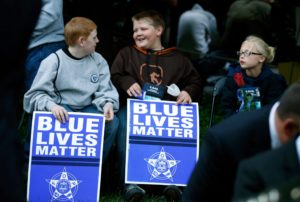
The deadly police ambush in Dallas last Thursday that left five officers dead and and seven others severely injured has state lawmakers across the country scrambling to pass additional “Blue Lives Matter” legislation. Such a bill would extend hate crime protections to police officers and emergency response personnel.
According to Think Progress, two so-called “Blue Lives Matter” bills have already been introduced since the mass shooting, both of which are modeled after the legislation passed in Louisiana earlier this year.
Wisconsin Rep. David Steffen (R-WI) announced his “Blue Lives Matter” initiative just one day after the deadly Dallas attack, Think Progress reports. His legislation would work to impose serious consequences on those who target police officers, EMT personnel and firefighters in the state.
“Over the past several weeks I have been working on the ‘Blue Lives Matter’ initiative, which works to protect those who protect us,” Steffen said in a statement. “I strongly believe that anyone who targets these brave men and women, solely because of their profession, should face serious penalties. This legislation sends a clear message that the despicable attacks we’ve seen against officers throughout the country will not be tolerated in Wisconsin.”
Shortly after Steffen’s announcement, two Florida representatives said they would pass similar legislation in their home state as well, Think Progress reports.
According to the Tampa Bay Times, State Rep. Dennis Baxley and Rep. Neil Combee have vowed to pass a law that would make killing a cop or firefighter a hate crime.
“Law enforcement officers hold the fabric of our society together,” said Baxley, who is in the middle of a tough Republican primary battle for a seat in the Florida state Senate. “An attack on them is an attack on our tradition of ordered liberty, and we must do everything possible to hold individuals who do them harm accountable.”
Kentucky state Rep. Kevin Bratcher also proposed a “Blue Lives Matter” bill one day prior to the horrific shooting, according to Think Progress. Crimes against officers in the state are currently deemed capital offenses.
” ‘Blue lives matter’ is what the title originally was for this bill, and it doesn’t demean any other ‘lives matter,’ ” Bratcher said. “I’m one of those that believe all lives matter.”
Many of the “Blue Lives Matter” bills that have popped up in the wake of Thursday’s massacre are modeled after Louisiana’s legislation, which was enacted in May of this year. According to Atlanta Black Star, the Pelican State became the first in the U.S. to pass such a bill that would expand hate crime protections to police officers and EMS workers.
“The men and women who put their lives on the line every day, often under very dangerous circumstances, are true heroes and they deserve every protection that we can give them,” said Louisiana Gov. John Bel Edwards, who signed the controversial legislation. “They serve and protect our communities and our families. The overarching message is that hate crimes will not be tolerated in Louisiana.”
While the laws are designed to better protect cops, many civil rights organizations are worried the bills will only do more to punish marginalized communities, Think Progress reports.
It also puts Black protesters at risk, as many have taken to the streets to demand justice for Philando Castile and Alton Brown, an African-American man recently gunned down by police in Louisiana’s capitol of Baton Rouge. According to the news site, demonstrators who damage squad cars or gather on police property can be charged with hate crimes, too.
Traditionally, the hate crime label has been used to describe crimes where the victim is targeted due to his/her race, religion, ethnicity, gender or sexual orientation. “Blue Lives Matter” legislation then poses a problem, as it attempts to lump one’s chosen profession into the same category with permanent traits like race and ethnicity.
It is also argued that Blacks and other minorities have no such bill to protect them from state-sanctioned violence, so why should police?
“[A hate crime] has to be against something intrinsically tied to someone’s sense of self, someone’s immutable characteristics, things they can’t change,” Stetson Law professor Charles Rose told the Tampa Bay Times. “It has nothing to do with someone’s profession.”