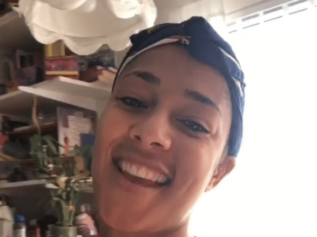
Kiersey Clemons Instagram/Paper Magazine
Kiersey Clemons is calling out Hollywood for its focus on fair-skinned Black women in acting roles. The 22-year-old realizes that colorism is a factor in casting decisions, and she discusses her privilege in a new interview to promote her upcoming movie, Neighbors 2: Sorority Rising.
“I agree that lighter-skinned women get favored in Hollywood, and I’m not proud to say that,” she told BET. “I don’t like it, but unfortunately, that’s what it is, because we have set up this idea of what beauty is, and that’s why there’s only one Lupita [Nyong’o]. There should be dozens of Lupitas.”
Continuing praise for the Tony Award nominee, Clemons says Nyong’o has “made a career out of embracing her culture and no one else has ever done that and that’s crazy. There’s more women like her, and we don’t get to see them.”
The California native, who starred in the critically acclaimed indie film “Dope” in 2015, said she grew aware of colorism among Black actresses when she was cast in the coming-of-age drama.
“I got some tweets about how none of us were darker, and I got very defensive because I took it personally,” she tells the network. “Because… well… I didn’t cast the movie; I didn’t make the movie.”
Clemons also points out that the “Dope” filmmakers have ties to women with darker skin tones or have the characteristic themselves.
“But also, we have to realize [director] Rick Famuyiwa is married to a dark-skinned woman,” she continues. “Kim Coleman, the casting director, is a darker skinned woman. And this was an indie film that was made and Rick’s casting was purely based off of talent and, unfortunately, I feel like maybe some of the girls didn’t make it into the room because maybe they’ve been discouraged by the people that allow you to get into the room, which are your agents.”
Because of the “line of people you have to go through” at movie castings, the film and TV actress, who starred in CBS’ “Extant,” said it is difficult to specifically blame someone for industry colorism.
“But when you look at the bigger picture, it’s society. And until society changes there’s not gonna really be a change in Hollywood,” she said.
Clemons is not the first young actress to acknowledge colorism in the industry. At a an appearance on the Hollywood Confidential Panel in 2013, KeKe Palmer said colorism is ongoing in Tinseltown. She opened up about the struggle of accepting her beauty at a young age.
“When I was like 5 years old, I used to pray to have light skin,” she told the panel. “Because I would always hear how pretty that little light skinned girl was, or I would hear I was pretty ‘to be dark skinned.’ It wasn’t until I was 13 that I really learned to appreciate my skin color and know that I was beautiful.”