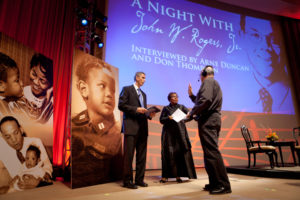
Secretary Arne Duncan at “A Night with John Rogers,” a 2010 event by The HistoryMakers (US Department of Education)
The Chicago-based non-profit, The HistoryMakers announced Friday it is releasing their digital archive to 10 universities around the country, leading up to a minority fellowship offer with three of the nation’s universities.
The video interview archive will be open to universities by subscription. The Chicago Tribune reports Northwestern University, University of Chicago, Boston University, Harvard University, Yale University, Princeton University, Howard University, Emory University, Carnegie Mellon University and Cornell University have signed up for the service to allow students and professors to access the footage through their library systems. Subscribers will be able to access raw interviews along with biographies and transcripts, which will make it simpler to view oral histories for certain topics.
Sarah Pritchard, dean of libraries at Northwestern told The Tribune, “We hope that what people learn is how much more inclusive they have to be when they start studying these subjects. They have to include a much wider range than they might have previously been aware of, and we have the tools now to do that.”
According to The HistoryMakers website, video interviews feature African-Americans in various fields including media, business, military, politics, music, civics, religion and science. The non-profit is also collaborating with Harvard, Yale and Emory to create a fellowship for minority students. Continuing from a 2009 grant, the 2016 Minority Archival Fellowship will allow each university to appoint a visiting archivist who has recently received a master’s of library science degree.
The goal of the program is to provide valuable, intensive professional post-graduate training at the selected universities in rich African-American archives. The fellowship is meant to build and support a network of individuals who are all committed to one goal: increasing the diversity of their professions.
Applications opened in the spring, and 2016 Visiting Minority Archival Fellows will improve their skills in maintaining and giving increased access to a certain African-American archival collection. They will also show that they have gained more knowledge in Black history and culture through the archives.
The HistoryMakers was founded by Julieanna L. Richardson in 1999. She began recording interviews in 2000, and the non-profit organization now hosts the largest recorded collection of African-American video oral histories in the nation. The Tribune reports there are now more than 2,700 video interviews available with 9,000 hours of footage.