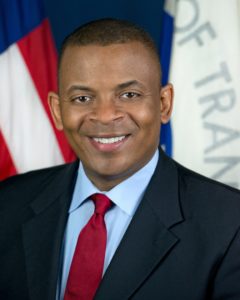
Anthony Foxx
Transportation secretary Anthony Foxx wants to change the way the nation handles highway construction. Foxx is trying to raise awareness about the fact that, in the past, new highway construction often devastated Black neighborhoods.
This is a subject Foxx has personal experience with, according to The Washington Post. As a child growing up in Charlotte, N.C. he witnessed how highways were routed through Black neighborhoods. He said the new highway did little to help the neighborhood.
According to The Atlanta Black Star, transportation is often an unglamorous issue that few people stop to think about. But, like most things, it can get very political. If you don’t have a car and rely on public transportation to get to work, it becomes a major issue when your neighborhood isn’t adequately served by buses and trains.
A Washington Post article revealed that many people find themselves in a cycle of poverty, and transportation was one of the issues causing this. The Brooking Institution found that 15 of the worst transit system were in the South, where Republicans refused to approve tax increases that would have funded transportation improvements. This only worsened the vicious cycle of poverty because poor people couldn’t get transportation to good-paying jobs. The Post article also detailed the struggles of Lauren Scott, a single mother struggling to find a good-paying job in Atlanta while relying on public transportation.
“This city [Atlanta] hasn’t built out its society,” said Deborah Scott, executive director of an area nonprofit organization, Georgia Stand-Up, in a Washington Post article. “We’ve given the suburbs to the poorer people, but the opportunities aren’t here.”
According to The Post, Foxx plans to launch his campaign to discuss how transportation affects urban communities at a Rotary Club speech in Charlotte, N.C.
Foxx’s speech will cite cases in Seattle, Los Angeles and Baltimore, where the creation of major highways resulted in the bulldozing of Black neighborhoods.
In some cases, new highway construction was a way to kill two birds with one stone. Poor, blighted neighborhoods were seen as an eyesore. By bulldozing them to make room for a new highway, city officials could get rid of what they perceived as “slum areas.”
But Foxx said some of the neighborhoods that were leveled were not poor. Some of them were areas full of blue-collar families.
“African-American communities like mine really suffered,” Foxx said, “and it wasn’t just African-American communities. There were blue-collar communities and other ones that felt the brunt of this big movement.”