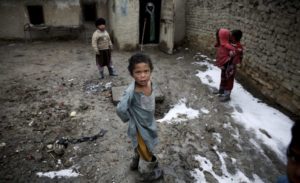
Afghan internally displaced children stand in a muddy yard at a poor neighborhood in Kabul, Afghanistan.(AP Photo/Massoud Hossaini, File)
BANGKOK (AP) — A United Nations report says the world’s least developed countries need access to electricity if they are to break out of poverty.
The report by the U.N. Conference on Trade and Development released Wednesday urges wealthy nations to do more to honor their aid commitments to help bridge the energy gap.
It says 60 percent of people in the world’s poorest countries, 47 of which meet the U.N.’s standards for being “least developed,” have no access to electricity — some 577 million people in total.
Access to stable supplies of electricity is crucial for helping businesses in developing countries grow.
More than 40 percent of businesses in the countries covered in the report suffer from inadequate, unreliable and unaffordable power, it said. They report an average of 10 power outages a month, each lasting about five hours, that cost them 7 percent of the value of their sales, it said.
“Energy as a source of transformation is one of the key issues of economic development and this is what we are trying to contribute to, specifically for the least developed countries,” Mukhisa Kituyi, secretary-general of UNCTAD, told reporters in Bangkok.
There is a shortfall of $1.5 trillion in funding to help meet the goal of universal access to power by 2030, Kituyi said.
The report said it would cost an estimated $12 billion to $40 billion in annual investment and a more than tripling of the annual rate of gaining access to electricity in those countries.
The countries covered in the report include 33 in Africa, nine in Asia, and five in the South Pacific and Caribbean.
The U.N. is encouraging governments in those countries to adopt policies to attract investors and improve use of their energy resources. Kituyi said it was still difficult for those nations to tap private sources of financing for poverty alleviation.
“The world has come to a point where we say that many solutions to development are best triggered by the private sector,” Kituyi said. “But you cannot say that about the least developed countries. You cannot leave it to the private market to fix Laos and Bangladesh, and Cambodia challenges.”
Renewable energy has the potential to play a revolutionary role in such countries. So far, most of those initiatives have been small scale, and the U.N. is urging that use of such technologies be scaled up to be useful for public utilities.