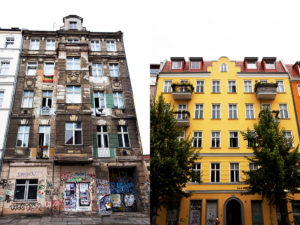
Gentrification. What are we to make of it, and why is it necessary? Must a community become a white space in order for its residents to enjoy decent goods and services? Why can’t everyone live in a decent neighborhood without gentrifying? And what are the consequences for the people who already live in the neighborhood? What happens if they can no longer afford to live in the place they call home? It is an issue that people across the country are facing.
In New York, as DNAInfo reported, Mayor Bill de Blasio’s zoning plan has been approved by the City Council, part of his effort to create or preserve a total of 200,000 affordable housing units by 2024. The features of the measure include Zoning for Quality and Affordability, an effort to enable more affordable housing and senior housing by eliminating parking requirements and increasing building heights, and Mandatory Inclusionary Housing, which will rezone communities and mandate affordable housing.
The mayor has selected 15 neighborhoods to begin the process of his new plan. And so, the struggle for even deeper affordable housing will be taken to the neighborhoods. Apparently, there is a concern among community advocates that the new plan does not go far enough. Ava Farkas, executive director of the Metropolitan Council on Housing, said the city’s plans are “not good enough,” telling DNAInfo that it “is not an affordable housing plan, it’s a gentrification plan.”
At issue is AMI, or area median income. Under the City Council measures that just passed, a council member has the option to mandate different percentages of permanent affordable housing for residents making anywhere from 40 percent of AMI — which is an income of $31,000 for a family of three and monthly rent of $775 for a two-bedroom apartment — to 115 percent AMI. However, those who disagree with the current plan are seeking an option for people making 30 percent of AMI, which amounts to $23,000 annual income. Otherwise, if the majority of housing built in low-income communities is market rate, low-income people of color will continue to be dislocated, replaced by wealthier whites. And there goes the neighborhood, so to speak, as MIH becomes “Missing In Harlem” for current residents, as DNAInfo reported.
A new proposal from Council Speaker Melissa Mark-Viverito of East Harlem would allow a 30 percent AMI affordable option and would mandate that half of new housing be affordable.
Meanwhile, across the country in San Francisco is a cautionary tale on the potential harms of gentrification, when the “gentry” in the newly gentrified communities they inhabit do not feel sufficiently comfortable, and feel threatened from “outsiders” who are actually the folks who were living there all along.
Alejandro Nieto, 28, was killed on March 21, 2014, pumped with 14 bullets from four San Francisco police officers, as The Guardian reported. He was a Buddhist, a son of Latino immigrants, and a licensed security guard who carried a Taser and had a clean record. Further, he had earned a degree in criminal justice from community college, with hopes of becoming a probation officer:
Nieto died because a series of white men saw him as a menacing intruder in the place he had spent his whole life. They thought he was possibly a gang member because he was wearing a red jacket. Many Latino boys and men in San Francisco avoid wearing red and blue because they are the colors of two gangs, the Norteños and Sureños – but the colors of San Francisco’s football team, the 49ers, are red and gold. Wearing a 49ers jacket in San Francisco is as ordinary as wearing a Saints jersey in New Orleans. That evening, Nieto, who had thick black eyebrows and a closely cropped goatee, was wearing a new-looking 49ers jacket, a black 49ers cap, a white T-shirt, black trousers, and carried the Taser in a holster on his belt, under his jacket.
There is a sense that Nieto would still be alive if he were white. And gentrification is having its effect on a city where a culture clash is taking place, and the wealthy feel they should not have to deal with the urban problems of homelessness and poverty. The Silicon Valley culture that is encroaching upon the city’s indigenous communities represents a white male environment in which few African-Americans or Latinos are allowed. As The Guardian noted, as of 2014, Google’s Silicon Valley employees were a mere 2 percent Black, 3 percent Latino and 70 percent male.
With the higher property values, rents, taxes and displacement that come with gentrification, development projects must be done in a holistic manner with community input and engagement, if there is to be any equity and benefit to residents of color. As long as a better community, a better standard of living, quality goods and services and safe neighborhoods are associated with white, affluent spaces, then the only change that will ever come will be of the negative and destructive variety.