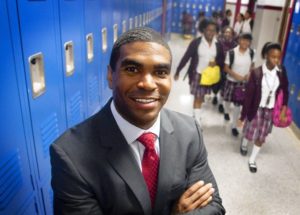
Dallas Dance poses for a portrait at the Young Women’s College Preparatory Academy (Baltimore Sun)
A superintendent in Baltimore is investing in a mentor program for young men of color. WBAL-TV reports Dr. Dallas Dance wants to launch a schoolwide mentorship program that will help at-risk Black and Hispanic men.
Dance announced his plans at a luncheon after a student showcase, where members of the Baltimore County business community – many who donate to programs – attended. The goal is to have the mentors in place to guide young men who are at risk of failing since many men of color in local classrooms end up suspended.
“In grades seven [through] 12, 40 percent of our African-American students, male students in general, and 31 percent of our Hispanic males have been suspended, compared to 23 percent of their white male counterparts,” said Dance.
According to Vice, suspensions have been an issue in Baltimore schools along with arrests. Due to a lack of leadership and criminalization, suspensions, expulsions and arrests happen often and mostly discriminate against minorities. The New York Times reports that an overhaul of school disciplinary practices occurred in 2007 when new chief executive officer Andres Alonzo was hired. In the 2009 -2010 school year, suspensions decreased 50 percent from the 2004 school year, according to The Baltimore Sun.
Mentorship programs targeting Black males and other minorities go beyond high school. USA Today reports that major state universities are developing programs to help increase performance for disadvantaged students. The University of Michigan, Ann Arbor; the University of Nebraska; and the University of Maryland are on board with these programs. The University of Maryland developed a diversity program in 2010, and one of its initiatives aims to address the achievement gap between white and Black students. Kumea Shorter-Gooden, chief diversity officer at the college, said public universities who receive public funding have an obligation to educate those they serve.