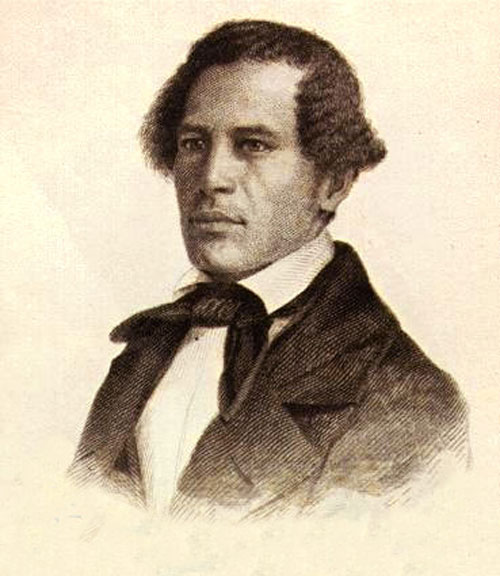
William Wells Brown
Early Years
Brown was born an enslaved African in Kentucky, in November 1814. He spent most of his childhood and young adult life as an enslaved African in St. Louis, Missouri working a variety of trades. In his book, William Wells Brown, Ezra Greenspan says that because Brown was given the job of tending to a young man also called William, his name was changed to Sandford.
Road to Freedom
According Greenspan, Brown tried unsuccessfully to escape slavery several times. He finally fled St. Louis at age 19, while docked in Cincinnati, Ohio. He eventually retook his own name, William, and added “Wells Brown” in honor of the Quaker who had rescued him from starving and freezing in Ohio.
Life as a Free Man
The State Historical Society of Missouri says that Brown, now a self-made free man, made his way to Cleveland, where he spent years working on a Lake Erie steamboat to help others escape slavery into Canada.
Brown settled in Ohio, married a free African-American woman, and had two daughters. While working to help free slaves, Brown became more involved in the abolitionist movement and relocated to Farmington, New York where the movement was strong.
The Lecturer
By 1843, Brown was lecturing on his experience as an enslaved African as well as lecturing on behalf of women’s rights and temperance laws. The State Historical Society of Missouri states that Brown worked on behalf of the Western New York Anti-Slavery Society as a lecturer for four years. In 1849, Brown went to England to lecture and stayed for five years due to the passage of the Fugitive Slave Act of 1850.
His Writings
While in England, Brown published his book, Narrative of William W. Brown, a Fugitive Slave. He wrote two additional books, Three Years in Europe and Clotel, the earliest known African-American novel. In 1855, he published The American Fugitive in Europe. Brown’s play, The Escape, was the first play ever to be published by an African-American.