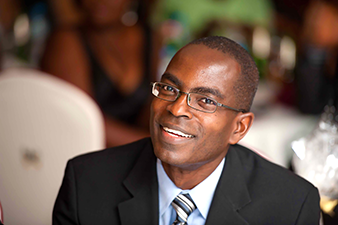
Patrick Awuah
When Patrick Awuah founded Ashesi University in his native country, Ghana, in 2002, he had a plan: Identify the nation’s future leaders, and give them a liberal-arts education. Classes started that March, with 27 students enrolled.
Over a decade after Ashesi opened its doors, Mr. Awuah was selected as a 2015 MacArthur fellow for his work at the institution. Awarded annually by the John D. and Catherine T. MacArthur Foundation, the fellowships include a $625,000 stipend, and they go to creative people in a range of fields. This year Mr. Awuah was the only leader of a higher-education institution to be recognized.
When Mr. Awuah was growing up in Ghana, he learned mostly by rote. He thought learning was the same as studying, he says — that it meant cramming facts, and then repeating them to a teacher. When he moved to the United States to study at Swarthmore, he was exposed to a liberal-arts curriculum for the first time.
“In kindergarten we were allowed to play and tinker with stuff, but after kindergarten my education didn’t really involve open-ended exploration,” he says. “At Swarthmore, I could tinker.”
Ashesi’s liberal-arts curriculum, which was designed in part by a group of American professors, is modeled on Swarthmore’s. So is Ashesi’s honor code: Students at Swarthmore complete closed-book take-home exams, a practice Mr. Awuah had never seen before coming to the United States.
“This was unheard of in Ghana, that students would be that trusted,” says Mr. Awuah, who worked as a program manager at Microsoft in the United States before returning to Ghana. “It is extremely important in developing countries — where so few people get access to the highest levels of education — that those people who do are deeply ethical.”
Today, just under 700 students are enrolled in Ashesi. Twenty-five percent of students don’t pay any tuition — normally around $11,000, including room and board — while another 25 percent get some form of financial aid, Mr. Awuah says. Almost all of Ashesi’s graduates are employed, in graduate school, or starting their own businesses within six months of graduation, the university’s Career Services Office reports.
Mr. Awuah thinks that ineffective leaders contribute to many of Ghana’s problems, and he hopes Ashesi will help change that. “Almost by definition,” he says, “the people in the universities and colleges are going to be future leaders of the country.” — Ellen Wexler
Read more at chronicle.com