 South Africa has the highest number of dollar millionaires in Africa, according to a new report.
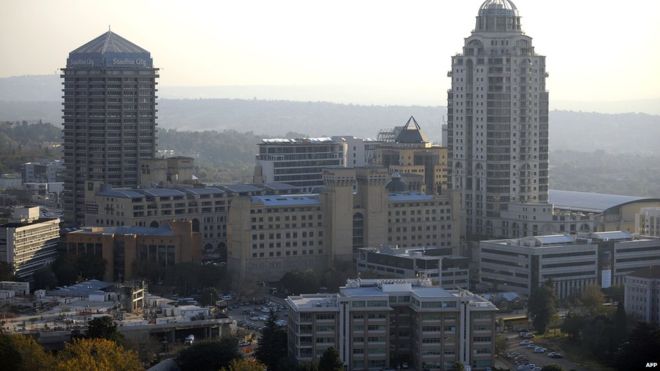
According to a report by AfrAsia Bank and New World Wealth, Johannesburg alone, known as the “city of gold”, is home to 23,400 millionaires. South Africa has 30% of the total.
Egypt’s Cairo comes second with 10,200, with Nigeria’s Lagos third with 9,100.
The study defines millionaires as people with net assets worth at least $1m (£650,000).
It estimates there are close to 163,000 millionaires living in Africa, with a combined wealth of $670bn (£440bn).
The number of millionaires is rising fastest in Ghana’s capital, Accra, the report said, even though at the moment, with 2,300, it does not make the top five.
After Lagos, comes Cape Town with 8,900 and Nairobi with 6,200.
It may come as a surprise to many that Johannesburg has more than twice the number of dollar millionaires as Lagos, the economic hub of Nigeria, Africa’s most populous nation and its number one economy.
However, Nigeria became Africa’s largest economy only recently, whereas South Africa has been at the helm for as long as I can remember and remains the most industrialised economy in Africa.
Being a citizen of the “city of gold”, as Johannesburg is known in local languages, I can see the money every day.
South Africa’s current economic problems has not prevented the emergence of new black industrialists.
Economist Owen Nkomo and founder of Inkunzi Investments, told me that old money from the Johannesburg Stock Exchange companies, which is largely still in white hands 21 years after the end of apartheid, has been wisely re-invested.
But he also points to the government’s Black Economic Empowerment scheme, aimed at redressing the imbalances of white minority rule, as a key driver of the growing number of black millionaires.
I have seen for myself in places like Soweto when the new black bourgeoisie flaunt their wealth on Vilakazi Street, where Nelson Mandela once lived, over the weekend. But I have also seen the vast properties in Cape Town owned by white families.
All of this must not delude us, so we forget the plight of the poor majority.
South Africa with all its wealth still faces huge problems of unemployment, inequality and poverty. And that should give all of us sleepless nights as we celebrate Africa’s wealth growth.
Read more at bbc.com