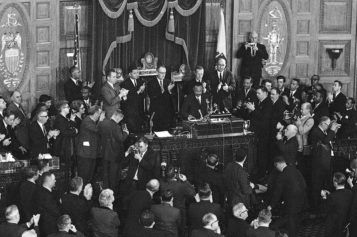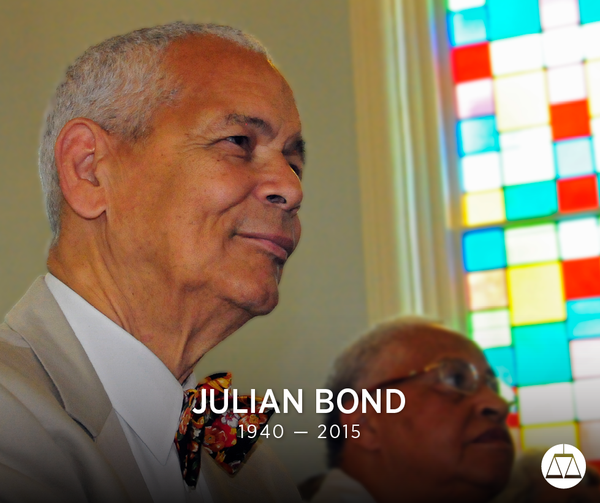
Civil Rights icon, Julian Bond, passes away at age 75. (Photo from SPLC)
Julian Bond, a lifelong civil rights leader and former board chairman of the NAACP, died Saturday night, according to the Southern Poverty Law Center. He was 75.
We’ve lost a champion. Rest in power, Julian. http://t.co/dTGmRcfOmD #JulianBond pic.twitter.com/pN3RwcVlbz
— SPLC (@splcenter) August 16, 2015
Bond, who was the SPLC’s founding president, died in Fort Walton Beach, Florida, after a brief illness, the statement said.
Bond, a Nashville, Tennessee native, was considered a giant of the 1960s U.S. civil rights movement. While a student at Morehouse College, Bond became a founding member of the Student Nonviolent Coordinating Committee in 1960 and served as its communications director for five years. Bond once said that SNCC “demonstrated that ordinary women and men, young and old, could perform extraordinary tasks”.
The NAACP mourns the passing of Chairman Julian Bond, civil rights titan and our brother. May he rest in eternal peace.
— NAACP (@NAACP) August 16, 2015
Bond later served as board chairman of the NAACP from 1998 until 2008, where he declined to run for another term. He taught at several colleges, including the University of Virginia at Charlottesville, where he taught history of the Civil Rights Movement.
On twitter, young civil rights activists honored and reflected the legacy of Bond’s work.
Rest in Peace brother Julian Bond. You contributed so much to our liberation. We will continue in your honor. pic.twitter.com/GEbR2L2VfU — The Dream Defenders (@Dreamdefenders) August 16, 2015
Rest In Peace, Julian Bond.
— deray mckesson (@deray) August 16, 2015
Rest in power to former #SNCC Communications Director. #JulianBond was a freedom fighter and taught us how to fight pic.twitter.com/CzU3T3W6xP — Million Hoodies (@MillionHoodies) August 16, 2015
Bond is survived by his wife, Pamela Horowitz, a former SPLC staff attorney, and his five children.