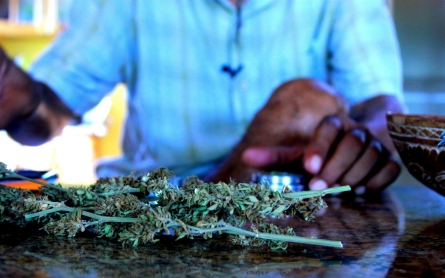
 KINGSTON, Jamaica — Eventually, the 2,500-gallon steamer that sits empty at a massive warehouse in Brown’s Town, Jamaica, will be pumping out spicy sauces infused with marijuana.
At least, that’s what Maurice Ellis is hoping.
The Jamaican business owner of Sun Spice Seasonings cannot help but grin as he admires the machinery he has already packed into his future seasoning factory. He imagines his will be a highly lucrative business in the coming years.
“It’s budding with excitement — pun intended,” he said, giggling. “I mean, there [are] huge opportunities now opening up.”
Ellis is among dozens of entrepreneurs hoping to cash in as a result of Jamaica’s newest marijuana laws. Earlier this year, the Jamaican Parliament decriminalized possession of small amounts and legalized use for medicinal, therapeutic and sacramental reasons. Now, households are now able to grow up to five plants.
For business owners such as Ellis, the change in the law has helped attract investors from all over the world.
“[Before the law changed], not many people paid much attention to our traditional spices and seasonings,” he said.
Now, he’s working with partners from California, Italy, and Canada to get his seasoning business up and running.
Many assume marijuana — or ganja, as the Jamaicans refer to it — has always been legal in Jamaica. According to Rastafarian elders, it is traditionally used in the Rastafari religion as a sacrament. But for decades, it has been illegal to have it.
“There are those of us who eat it [and] drink it,” said Ras Iyah V, a Rastafarian elder who has practiced the religion for 47 years and consumed marijuana for most of his life.
When he takes a puff of his home-grown “spliff,” smoke envelopes his face and embeds in his long, weathered, beard.
Iyah V is among those in the Rastafari community who have been prosecuted for using ganja.
“If you are in a Jamaican jail, you get a cardboard [that] you have to spread…on the concrete if you want to sleep,” said Iyah V, who acknowledged he has previously served jail time for marijuana-related offenses. “At certain times of the day, if you are so hot, you have to take off the shirt and use it to become a fan.”
He says the easing of Jamaica’s laws provides some relief to his community.
“We were relieved and know that if your family is going down the road and the policeman stop you [with] herb in the vehicle, you don’t have to go to jail,” he said. “That’s a good step in the right direction.”
Iyah V, who heads the Westmoreland Ganja and Hemp Farmers Association, also says he hopes local farmers will be recognized and financially rewarded for their ganja-growing expertise.
“The grassroots people who have suffered for it and the Rastafari community, [which has] bore the brunt of the persecution … will these people benefit from it?” he asked. “Or will it be the very people … who used to oppress us?”
Read more at america.ajazeera.com