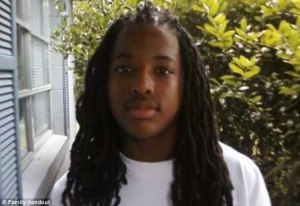
There are new developments in the case of Kendrick Johnson, a 17-year-old Black student found dead in a school gym in Lowndes County, Ga. in 2013.
CNN reported that federal marshals, warrant in hand, seized emails from the Lowndes County sheriff’s office on July 21 and 22 related to the federal grand jury investigation into the teen’s death. Government agents early Tuesday morning searched and seized property, including cell phones, computers, and other electronics, from the Jacksonville, Fla. area home of FBI agent Rick Bell, whose two sons went to school with Johnson. Similar searches were conducted on the two brothers, who live elsewhere and a girlfriend of one of the brothers, according to the Associated Press.
County investigators ruled Johnson’s death accidental, a case of “positional asphyxia,” claiming he got stuck while reaching for a shoe at the center of the gym mat. Meanwhile, a forensic pathologist hired by the Johnson family concluded the death was a homicide, with evidence of “unexplained, nonaccidental blunt force trauma.”
In October 2013, the U.S. Department of Justice began a federal investigation. Earlier this year, as the Atlanta Journal-Constitution reported Johnson’s parents, Jacquelyn and Kenneth Johnson, filed a $100 million wrongful death lawsuit. The suit, which names local law enforcement and the city of Valdosta as defendants, alleges a female lured their son into the gym, where two brothers—former classmates of Johnson—beat the Black teen to death at the behest of their father Rick Bell, a local FBI agent. The suit accuses school officials, law enforcement and the Georgia Bureau of Investigation of conspiring to protect the brothers.
The Bell family countersued, accusing the Johnsons of using “others as their authorized agents to post messages on various social media, including Facebook, Twitter, blogs, instant messaging, and the like, that were defamatory of the Bells.” The Bells also sued Ebony magazine in a $5 million slander and libel suit, based on articles accusing their sons—through the use of aliases—of being involved in Kendrick Johnson’s death.
Benjamin Crump, co-counsel for the Johnsons, who also has represented the family of Trayvon Martin in the George Zimmerman case, of Michael Brown, who was killed by police in Ferguson, Mo., and Tamir Rice, who was shot to death by Cleveland police for holding a toy gun, told the Atlanta Journal-Constitution that federal prosecutors are convinced Kendrick Johnson’s death was not accidental.
Brian Bell, one of the agent’s sons named in the Johnson wrongful death lawsuit, posted his reactions to the federal on social media, as was reported in First Coast News:
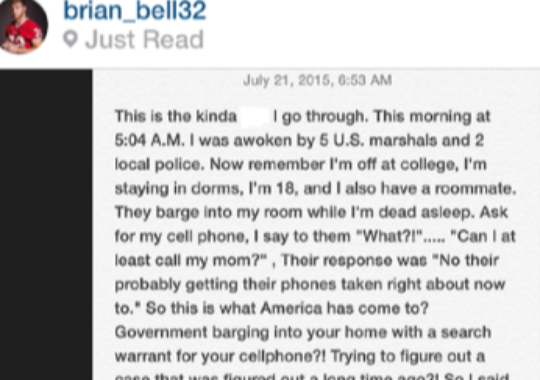
Rick Bell’s son, Brian, posted this to Instagram. (Photo: Instagram)
Johnson’s parents, who also filed a lawsuit against the Lowndes County Board of Education and the board members, have been fighting for over two years to establish the truth and seek justice for their son.
Kendrick Johnson, not unlike other young Black people, ended up dead and the authorities claim there was no foul play. When Black people die, often it is ruled a suicide or an accident, and the victim is blamed for his or her own death. One has to wonder how a young man is found dead, rolled up in a gym mat, and no one is responsible. The feds seem to agree.
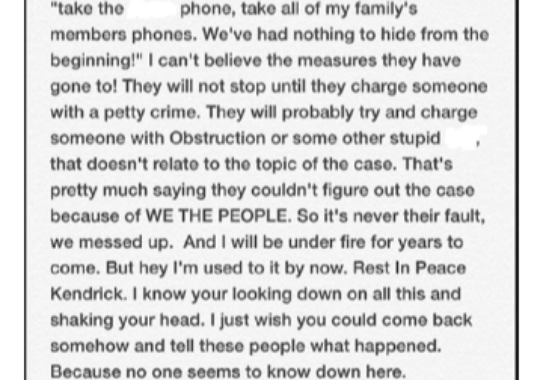
Brian Bell’s Instagram (Photo: Instagram)
Given the mysterious deaths of Sandra Bland in Waller County, Texas, 18-year-old Kindra Chapman in Ala., and Kendrick Johnson in Lowndes County, Ga., we are reminded that #BlackLivesMatter and justice must be done.