President Barack Obama’s election marks the beginning of the Third Reconstruction.
In an interview conducted by Annabel Park and Eric Byler of Story of America, the Rev. William Barber, president of the North Carolina NAACP, described the three different eras of Reconstruction. The first was the 1860s era following the Civil War that the history books acknowledge. He explains that the second era of Reconstruction occurred during the 1960s. The Black people of this era saw advances, such as the March on Washington and the Civil Rights Act of 1964, as well as setbacks, such as the deaths of Martin Luther King Jr., Malcolm X and Medgar Evers. Barber concluded by saying that the election of Obama “represented the possibility of a third Reconstruction” due to his utilization of fusion politics.
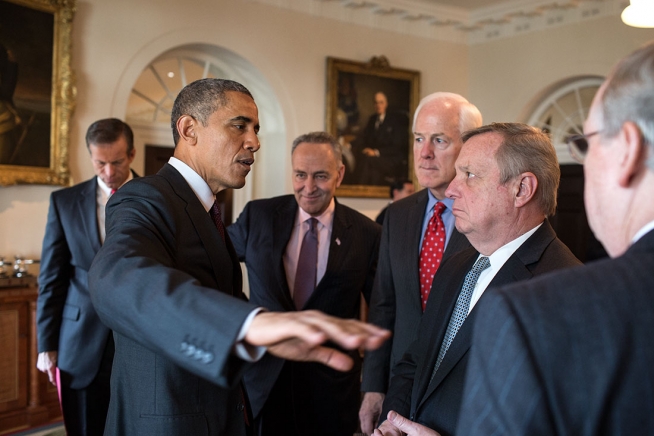
via whitehouse.gov
The use of fusion politics characterizes the Era of Obama.
Fusion politics is demonstrated by a coalition of different political parties working together; this is often referred to as “electoral fusion.” Barber has conveyed that negative political consequences always come about after the use of fusion politics. This was evident during Reconstruction, and this is evident today. Barber went on to state that the political consequences take on the form of legislative attacks on taxes, education, labor, criminal justice and voting rights in order to bring an end to the use of fusion politics and Black political success.


