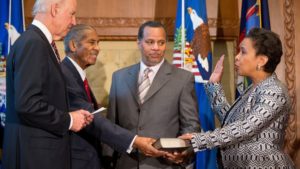
Loretta Lynch sworn in by Vice President Biden while her father Lorenzo Lynch and husband Stephen Hargrove hold the Bible
When it comes to protecting Black people from the excessive force of abusive cops, Loretta Lynch starts her first full day as US Attorney General inheriting a legacy of failure.
For all his sympathetic talk about understanding the frustrations of Black parents who have to warn their children about encounters with police, a talk he once said he had to have with his own son, Lynch’s predecessor, Eric Holder, was unwilling to bring civil rights charges against against the killer of Michael Brown in Ferguson and the killer of Trayvon Martin in Florida. Justice hasn’t yet made decisions about charging the killer of Eric Garner in New York or the killer of Tamir Rice in Cleveland.
Holder told Politico in February, after the department’s Trayvon Martin announcement, that the bar in these cases was too high to pursue civil rights prosecutions. He said the system needed a lower standard of proof for civil rights crimes to make it easier for the federal government to bring charges.
“I think that if we adjust those standards, we can make the federal government a better backstop — make us more a part of the process in an appropriate way to reassure the American people that decisions are made by people who are really disinterested,” he said. “I think that if we make those adjustments, we will have that capacity.”
Even though the Justice Department has failed to be the backstop that the Black community is seeking, Holder wanted the department to get some credit for its reports slamming police departments such as the ones in Cleveland, Seattle and Ferguson and other cities for discriminatory practices.
“We have done independent, thorough investigations in all of the matters that we have examined, and we have brought record numbers of cases against police departments around this country,” he said. “I don’t think anybody would be able to look at this Justice Department over the last six years and say that we’ve been anything other than aggressive in trying to root out inappropriate police conduct while, at the same time, trying to establish — or reestablish — bonds of trust between communities of color and people in law enforcement.”
Whether Lynch is as concerned as Holder about squaring off against rogue police officers isn’t clear. But even if she isn’t she will inherit the controversial cases of Tamir Rice in Cleveland and Eric Garner in Staten Island—and undoubtedly others to come—so it immediately becomes a big item on her to-do.
She spoke in platitudes after she was sworn in about the task.
“We can imbue our criminal justice system with both strength and fairness, for the protection of both the needs of victims and the rights of all,” she said. “We can restore trust and faith both in our laws and in those of us who enforce them.”
To make any change in the standard of proof facing the Justice Department would require Congress—yes, the same Congress that made her wait longer than any attorney general in modern history to be confirmed. If Lynch has anything close to the relationship with Congress that Holder had, any major changes such as that are about as unlikely as a Ben Carson presidency. That means the public might as well begin preparing itself for more disappointments—and perhaps more explosions in angry Black communities.