 The emails of President Obama’s that were hacked by Russians were more invasive and concerning than the administration has let on, according to The New York Times.
The breach extended to emails from the president to people inside the White House and maybe some outside the building, to people with whom Obama frequently communicated, the newspaper reported. Emails he sent and received were compromised, according to officials briefed on the investigation.
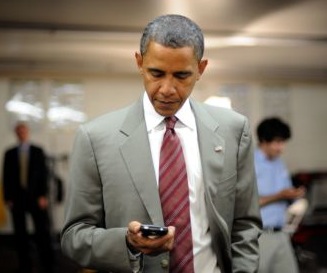
The hackers also got deeply into the State Department’s unclassified system, but apparently did not penetrate closely guarded servers that control the message traffic from Obama’s BlackBerry, which he or an aide carries constantly.
Officials did admit that the unclassified system routinely contains much information that is considered highly sensitive: schedules, email exchanges with ambassadors and diplomats, discussions of pending personnel moves and legislation, and, inevitably, some debate about policy.
White House officials said that no classified networks had been compromised, and that the hackers had collected no classified information. Many senior officials have two computers in their offices, one operating on a highly secure classified network and another connected to the outside world for unclassified communications.
Officials did not disclose the number of the president’s emails that were accumulated by hackers or the sensitivity of their content. Obama’s email account itself does not appear to have been hacked. Aides say that most of his classified briefings—such as the morning Presidential Daily Brief—are delivered orally or on paper (sometimes supplemented by an iPad system connected to classified networks) and that they are usually confined to the Oval Office or the Situation Room, The Times reported.
At the same time, senior White House officials have known for months about the depth of the Russian intrusion and that Obama’s communications were among those infiltrated. “This has been one of the most sophisticated actors we’ve seen,” said one senior American official briefed on the investigation to The Times.
Others confirmed that the White House intrusion was viewed as so serious that officials met on a nearly daily basis for several weeks after it was discovered. “It’s the Russian angle to this that’s particularly worrisome,” another senior official said.
The hacking happened at a moment of renewed tension with Russia — over its annexation of Crimea, the presence of its forces in Ukraine and its renewed military patrols in Europe, reminiscent of the Cold War.
Inside the White House, the intrusion has raised a new debate about whether it is possible to protect a president’s electronic presence, especially when it reaches out from behind the presumably secure firewalls of the executive branch.
In 2008, Obama’s campaign was hit by Chinese hackers. Nonetheless, he has long been a frequent user of email, and publicly fought the Secret Service in 2009 to retain his BlackBerry, a topic he has joked about in public. He was issued a special smartphone, and the list of those he can exchange emails with is highly restricted.
Many find it curious that the White House has been slow to reveal its conclusions about who was responsible for this complex and artful intrusion into the government. After all, Obama called out North Korea for ordering the attack on Sony Pictures Entertainment, among other cases.
CNN reported that hackers had gained access to sensitive areas of the White House computer network, including sections that contained the president’s schedule. The White House spokesman, Josh Earnest, said the administration had not publicly named who was behind the hack because federal investigators had concluded that “it’s not in our best interests.”


