(Photo by Victor Alcorn)
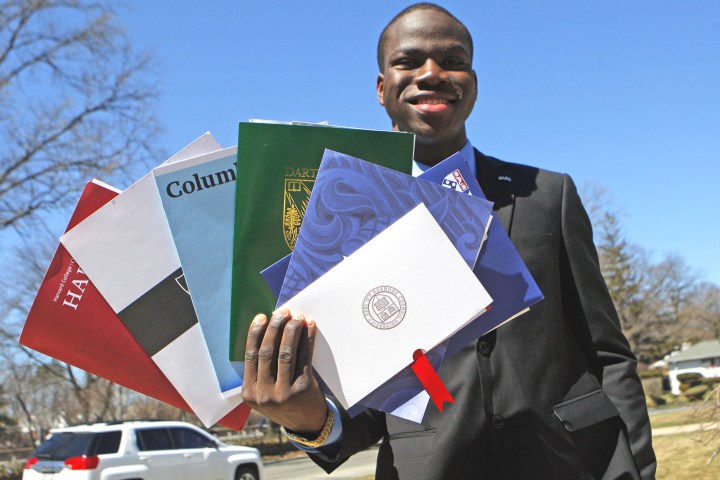
The average high school graduate would be fortunate to get acceptance letters back from more than half of the elite universities they applied to—and getting into just one Ivy League school would be a joyous accomplishment worth celebrating. That’s exactly what makes Harold Ekeh’s acceptance into all eight Ivy League schools so remarkable.
Value education and value opportunity.
That’s the message 17-year-old Ekeh touted after he got accepted into more than a dozen universities.
Ekeh, like many other students, took the time to apply to a plethora of universities as his high school graduation lay just over the horizon.
Rather than dealing with the emotional rollercoaster of a few acceptance letters mixed in with some rejection letters, Ekeh opened all 13 of the letters from the universities he applied to and realized he had been accepted to all of them.
This list of 13 schools ready to welcome Ekeh to their campus includes all eight of the Ivy Leagues as well as other prestigious universities like Johns Hopkins and MIT.
Based on his academic achievements, it’s no surprise that all the schools wanted to make Ekeh a part of their student bodies.
The Nigerian-born teen who now resides in Long Island graduated high school with a GPA of 100.5 percent and boasts a 2270 SAT score out of a possible 2400.
He also has a demonstrated interest in STEM that makes him a promising candidate for any university.
Ekeh was one of the semifinalists for the national Intel Science Talent Search this year for his research on how the acid DHA can slow Alzheimer’s.
It’s a research project that was extremely personal for Ekeh whose own grandmother was diagnosed with Alzheimer’s when he was 11.
Outside of his grandmother’s diagnosis, Ekeh says he had a good life in Nigeria but his parents knew there was more opportunity for him in America.
“We had a fairly comfortable life in Nigeria, but they told me we moved to America for the opportunities like the educational opportunities,” he said, as reported by CNN Money.
These are the opportunities Ekeh has always cherished as they fueled his sheer drive and determination in the classroom.
When it comes to explaining how his incredible accomplishment was possible, Ekeh credits his parents.
“My parents’ hard work and my hard work finally paid off,” he said, according to the NY Post.
He added that he was “humbled” by the experience and insisted the accomplishment was not just a personal feat.
“It’s not just for me, but for my school and community,” he said, according to CNN Money. “We can accomplish great things here.”
Despite the plethora of options available to him, Ekeh believes he already knows what school he wants to attend.
“I am leaning toward Yale,” he added. “I competed at Yale for Model UN, and I like the passion people at Yale had.”
He has also already formed friendships with students at Yale as well as established great connections with mentors at the university.
If he indeed follows through with his decision to go to Yale, he will be following in the footsteps of another Long Islander who was accepted into all of the Ivy League schools—Kwasi Enin.
Enin is another African native who came to the U.S. as a child from Ghana and chose to attend Yale after he too was accepted into all of the Ivy League schools.