Flooded Vanport
It is not ironic that Portland, Oregon, is gentrifying faster than any city in America. Portland actually has a little-known legacy of helping to virtually wipe out a thriving African-American community in the 1940s.
The Smithsonian Institution in Washington, D.C., documents the tragedy of Vanport, Oregon, just outside of Portland. Blacks lived in a neighborhood called Albina. It was the only place Blacks were allowed to live at that time, a pristine utopia of plentiful land.
When whites were called to World War II, labor was needed, and Blacks migrated north to Portland. To handle the influx, Vanport was created — a comfortable place that rapidly grew. It was the second-largest city in the state and a hub for the vast Word War II-era shipyard business.
“With Portland’s black population undergoing a rapid expansion,” the Smithsonian notes, “city officials could no longer ignore the question of housing: There simply wasn’t enough space in the redlined neighborhoods for the incoming black workers, and moreover, providing housing for defense workers was seen as a patriotic duty. But even with the overwhelming influx of workers, Portland’s discriminatory housing policies reigned supreme. Fearing that a permanent housing development would encourage black workers to remain in Oregon after the war, the Housing Authority of Portland (HAP) was slow to act.”
At its height, Vanport housed nearly 40,000 residents, close to 40 percent African-American. All was good…until it wasn’t.
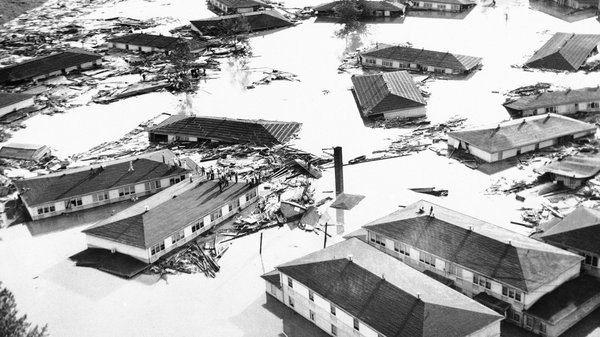
Persistent rain in 1948 created a hole in the railroad dike blocking the Columbia River, and it erupted into massive flooding. Instead of warning the residents of the dangerously high water levels, city officials elected not to evacuate, allowing the residents to be easy targets for the flooding.
The town was wiped out within a day, and 18,500 families were displaced, more than a third African-American.
The Smithsonian reports that Vanport’s collapse recreated the same overcrowding problem it was created to fix. Temporarily, the line of racial discrimination in Portland was bridged when white families offered to take in Black families displaced by the storm — but before long, the racial lines that existed before the flood formed yet again.
The total number of displaced Black residents was roughly equal to the entire population of the Albina neighborhood, making it impossible for displaced Black families to crowd into the only area where they were allowed to buy homes.
Portland has been a divided city ever since.
An 85-acre multipurpose land reserve called Delta Park is the only reminder Vanport ever existed. After the flood, discriminatory housing laws meant most African-Americans’ only option was to return to Albina. But their neighborhood that they loved was undergoing gentrification, leaving many American-Americans in Oregon struggling to find a place to call home in a state that only let them in 90 years ago.