Artists in Mozambique are certainly not lacking inspiration.
Whether they draw from their colonial past, independence, or the turbulent years of civil war that followed, many Mozambicans have taken to the canvas to express themselves. It’s no wonder the Mozambican art scene is taking the world by storm.
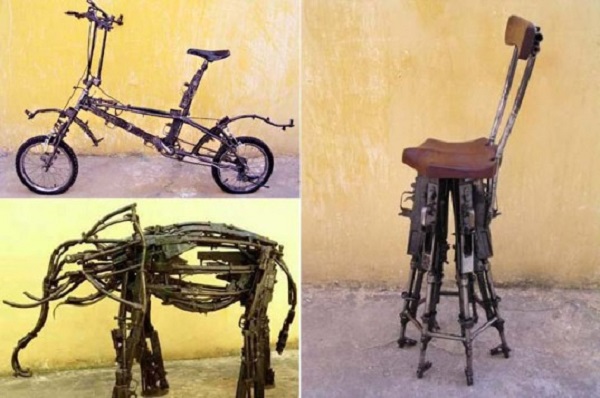
For Goncalo Mabunda, the 16-year civil war that ended in 1992 provided not only the muse but the materials for his works. His sculptures—intricate masks, thrones and figurines—are molded from recovered weaponry and military equipment, namely old land mines, AK-47s and rocket launchers.
Mabunda’s work was made possible through the efforts of the Christian Council of Mozambique, a group of local churches that launched the “Transforming Guns into Hoes Program,” which offers participants tools and building materials in exchange for recovered weapons.
“The war is over,” he said. “Why do we still need weapons? Let’s destroy (them). And I’m glad the government at the time said, ‘yes, let’s destroy’.”
For other artists, like Naguib Elias Abdula—whose half-mile murals are dotted throughout the landscape of Maputo, the country’s capital—independence was the spark plug that got him painting. In 1975, when Mozambique became its own country following a decade-long insurrection against Portugal, the land was covered in debris, and was very much a blank canvas. For Abdula, artwork proved the perfect medium to inform the public.
“At the time, it was necessary to teach the people what’s going on. What is independence? What is ‘Mozambique’? It was necessary to teach people, and people [didn’t] read, so we taught through paintings in the road,” he says, referring to the low literacy rate back then (literacy has risen to 58.6 percent, up from 38.7 percent in 1997, according to UNESCO).
Like Mabunda, Abdula’s work has achieved international acclaim following an exhibit at the United Nation’s headquarters in 1996. Since, he’s been shown in countries throughout the world. It is a narrative that is becoming popular in the country, which has started to gain a reputation as an incubator of fine arts.
“There is an artistic movement,” confirms Arturo Vicente, president of Maputo’s Nucleo di Arte, a longstanding exhibition space that showcases many of the country’s up-and-coming artists.
Source: CNN