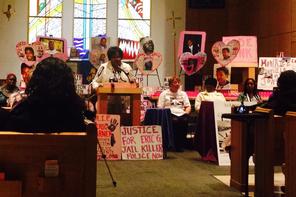
Mothers speak at First Trinity Lutheran Church in D.C.
As far as Washington lobbying groups go, they don’t get more powerful than this one: A delegation of nearly a dozen Black mothers from around the country whose unarmed sons were killed by police will be hitting Capitol Hill today to meet with lawmakers, after holding a moving rally last night at a church in D.C.
They spoke to a standing-room-only crowd at the First Trinity Lutheran Church, one-by-one telling their painful stories of how their sons died at the hands of law enforcement in different places, at different times. Their stories varied, but they all shared the aching pain they say never goes away. The presence of the delegation of 10 women at the church, some of whose sons were killed as long ago as two decades, was a chilling reminder of how long this phenomenon has been going on.
Before there was Michael Brown and Eric Garner and Tamir Rice, there were many, many others.
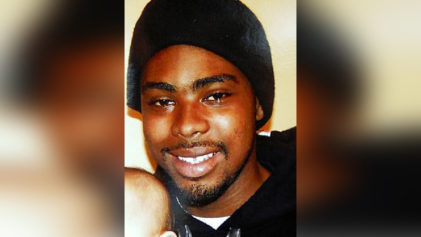
Some of their cases made national headlines when their sons were gunned down, such as Wanda Johnson, whose son Oscar Grant was shot in the back and killed by a transit police officer in Oakland in a case that was memorialized by the award-winning movie, Fruitvale Station. Or Valerie Bell, whose son Sean Bell was killed on his wedding day, on Nov. 25, 2006, when New York plainclothes officers fired a barrage of 50 shots fired into his car because they thought his friend had a gun. Bell is the founder of an organization called Mothers of Never Again (MONA).
The mothers are scheduled to join protesters at a rally Wednesday night at the Department of Justice, after spending the morning meeting with Congressional members and advocating for changes to see that police officers are prosecuted when they kill unarmed citizens.
“I used to say, ‘Well, it’s a few bad apples.’ We are past a few bad apples,” Collette Flanagan told the crowd last night.
Flanagan’s son Clinton Allen, who was 25, was killed on March 10, 2013, when he was shot seven times by a Dallas police officer as an unarmed Allen was leaving the apartment complex of a woman who had called 911 because Allen kept knocking on her door. The officer has never been charged with any crime and remains on active duty—which was a consistent theme in the stories of the mothers who gathered last night: the officers who killed their sons were never charged or were charged and acquitted.
Dorothy Elliott wanted the crowd to know that police killing unarmed Black men has been going on for years. Her son Archie was shot and killed by two police officers in Prince George’s County, Md., 21 years ago, on June 18, 1993, while his hands were cuffed behind his back in a cruiser after being pulled over for a DUI. Claiming that Elliott somehow pointed a handgun at them, the officers opened fire and unloaded 22 rounds, 14 of them striking Archie. No handgun was found, yet the officers, Jason Leavitt and Wayne Cheney, were acquitted.
In fact, Cheney went on to fatally shoot another man just a year later—and was also acquitted for that murder.
“The pain is still there,” Elliott said. “It’s even worse when you think there was no justice.”
The mothers said last night that they are encouraged by the protests that continue to rage around the country, giving them hope that lawmakers might be willing to listen this time.
“If people sit back and do nothing, it’ll continue to happen,” Elliott told a local D.C. television station, WJLA.
“Maybe not in my lifetime, but they’re fighting this cause. They’re out there every day, hoping that we will bring about change,” said Marion Hopkins, whose son Gary was shot and killed by police in Prince George’s County 15 years ago when he and his friends were leaving a dance after an altercation had broken out.