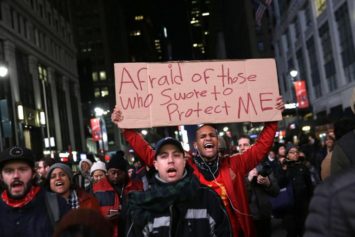
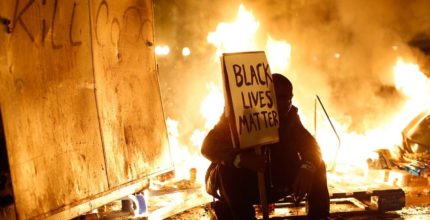
In the wake of the controversial grand jury non-indictments in St. Louis and Staten Island, despite all the protests that continue to rage around the country featuring people of different races expressing their outrage, there is still a racial divide in the country over whether police have different standards based on race—half of white people still say they don’t believe it’s true, while 82 percent of African-Americans say it is, according to a new NBC News/Marist poll.
Overall, 47 percent of Americans say that law enforcement applies different standards to Blacks and whites, while 44 percent disagree. But a deeper dive into the poll numbers shows the racial divide.
Asked whether they have a “great deal” or “fair amount” of confidence that police in their community will not use excessive force on suspects 72 percent of the public and 79 percent of whites say they do have that confidence. Only 43 percent of Black respondents say they do.
The poll was done on December 4-5, after the Eric Garner grand jury decision, surveying 1,018 adults with a margin of error of 3.1 percent.
The poll did not have good news for President Obama. Asked about the president’s handling of the grand jury decisions, 30 percent approve of the president while 46 percent disapprove. There were more disapprovals than approvals in every group, even among Blacks. Whites disapprove by 49 percent to 27 percent, Blacks disapprove 46 to 35 percent, and Latinos disapprove 38 to 36 percent.
The widespread protests and demonstrations across the country have definitely served to increase public awareness of these explosive issues—and to reduce the public’s confidence in the American legal system. Ninety-three percent of Americans say they have heard about the recent grand jury decisions in Staten Island and Ferguson, and 43 percent said the decisions decreased their confidence in the legal system. There were 17 percent who said the grand jury increased their confidence in the system.
Among Black respondents, seven in ten said the decision decreased their faith in the legal system, while 20 percent of whites say their confidence has increased.
As usual, there was a party divide in the confidence in the police: 35 percent of Democrats say they have “a great deal” of confidence in police in their community to do a good job enforcing the law, compared to 73 percent of Republicans. As for the question of whether the police apply different standards based on race, 64 percent of Democrats say they do while 64 percent of Republicans say they do not.
There has been a national conversation about whether police wearing body cameras might decrease the amount of police brutality—despite the fact that the Garner killing was caught on video. Americans are strongly in favor of the cameras: 76 percent of Americans say the police officers should be required to wear cameras, while 17 percent disagree.