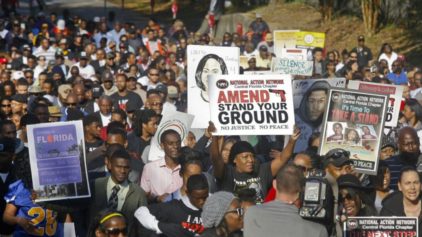
Marissa Alexander (center), the woman who is facing 60 years in prison for firing a warning shot at her husband during a domestic dispute.
Marissa Alexander, a Black mother of three who has been in an ongoing battle to gain her freedom after her arrest for firing a warning shot at her ex-husband, accepted a plea deal that essentially ends her case—but sends her back to jail for 65 days.
The terms of the plea that Alexander agreed to yesterday ordered her to serve three years in prison for two of the three charges against her. Since Alexander already spent 1,030 days in jail, she will return to jail another 65 days to settle the plea agreement, according to First Coast News.
“Her goal was to get this all behind her, to be able to be back with her family and move on with her life,” her lawyer, Bruce Zimet, said.
When she is released on Jan. 27, 2015, Judge James Daniel will decide what the sentence will be for the third charge of aggravated assault, according to US News. Zimet says Alexander could face up to two more years in prison.
“The state will address that in the Jan. 27th sentencing hearing,” Jackelyn Barnard, spokeswoman for Corey, wrote in an e-mail.
Last year, Alexander was released from prison just in time for Thanksgiving. She has been out and on strict house arrest since then. She went back to jail on Monday after accepting the plea deal.
The original incident occurred in August 2010. Alexander said she feared for her life when she was attacked by her former husband, who questioned her fidelity and the paternity of their new child. She was chased, strangled and verbally threatened by Gray Sr. When she was able to break away, Alexander fired a warning shot that didn’t hit anyone in the house.
The judge denied her immunity under the infamous “stand your ground” law because she didn’t believe that Alexander was in fear for her life. Alexander was found guilty of aggravated assault with a deadly weapon.
After spending three years in prison, Alexander returned home with probation and was under strict house arrest.
Alexander was due in court again on Dec. 8 because Florida State Attorney Angela Corey was trying to have Alexander serve 60 years consecutively—20 years for each of the three counts of aggravated assault.
The new hearing would have allowed testimony from three women who were previously abused by Alexander’s former husband, Gray Sr.
In a hearing earlier this month, Zimet tried again to get his client a “stand your ground” immunity hearing, but it was denied.
The “Free Marissa Now Mobilization Campaign” that has been supporting Alexander has vowed to continue organizing until she is free, according to its press release.
“The plea deal is a relief in some ways, but this is far from a victory,” Alisa Bierria, one of the leaders of the mobilization campaign, said. “The deal will help Marissa and her family avoid yet another very expensive and emotionally exhausting trial that could have led to the devastating ruling of spending the rest of her life in prison.”