 Bamboo does not get much respect in Ghana.
Farmers see it as a nuisance to be cleared from their land. Construction workers use it to prop up buildings under construction.
But Kwabena Danso thinks bamboo is worth more than that.
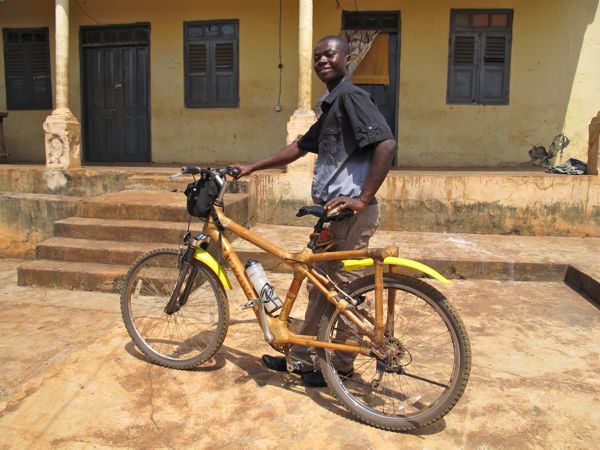
His company, Booomers International, has been making bicycle frames out of bamboo, sending them from the Ashanti Region village of Appah to Germany, the Netherlands, Australia and elsewhere.
Bamboo “has so many opportunities for the country. Like, as we want to go into other products, it’s a great opportunity for us revise and then get the people to know that there’s great advantage to bamboo,” Danso says.
Local workers
Danso says he hires young men from nearby villages and puts them to work, sanding, gluing and binding his bamboo frames.
His company churns out about 50 of the frames per month, using locally produced bamboo for the frames and cassava flour mixed with epoxy as one of the glues.
Bicycle frames are commonly made out of carbon fiber, steel or aluminum.
Besides being a successful social enterprise, Danso says, Booomers also serves as a source of livelihood for young men like foreman Abdul Razak.
Without this job, Razak says he would still be living at home with his parents.
“If there is this company it is not there, I don’t know where I’d be by now,” Razak says.
Danso has sold only a few of his frames within Ghana.
One of his customers, Walter Kudzodzi, purchased a bike earlier this year. Kudzodzi says his solid-wood frame rarely escapes notice when he goes for rides around his neighborhood.
“For example, on Saturday, I rode about five kilometers around my neighborhood and everywhere I went, people were just looking at me,” Kudzodzi says.
‘Try it’
“Once and a while you hear the exclamation, ‘Hey, it’s made out of bamboo, hey, that’s the bamboo bicycle,’ … and anytime I stopped to take a breather, people come close to me and say, ‘Wow, we heard about this, but this is the first time we’ve seen it. Is it functional? Does it work?’ I say yeah, try it,” Kudzodzi says.
With his shop overwhelmed with orders, Danso says Booomers is poised for expansion.
He says he hopes to get more of his frames on the streets, not just the roads of foreign countries, but on those in Ghana as well.
Source: voanews.com