Source: Cornell
At an Aug. 6 event in Lusaka, Zambia, the Cornell Law School and Zambia’s Center for Law and Justice released a new handbook for Zambian judicial officers and legal practitioners on juvenile law. Produced by the Avon Global Center for Women and Justice and the International Human Rights Clinic, both of Cornell Law School, and the Center for Law and Justice, the Handbook on Juvenile Law in Zambia is the first-ever practice guide on Zambian juvenile law.
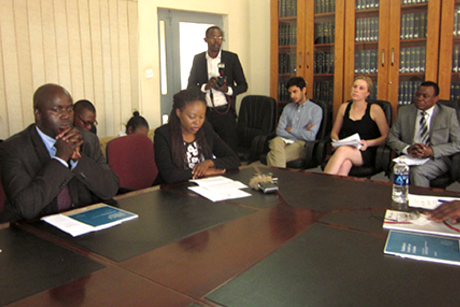
At the event, hosted by the Law Association of Zambia, a panel of Zambian juvenile-law experts, including magistrates, prosecutors and police, reflected on the handbook’s insights and discussed strategies to address challenges that prevent juveniles from accessing justice through the courts. Cornell Law School Professor Muna Ndulo, director of the Institute for African Development, moderated the panel.
Quoting former South African President Nelson Mandela, Ndulo pointed out “there can be no keener revelation of a society’s soul than the way in which it treats its children.” He observed, “It is shameful that after 50 years of independence, the Zambian justice system does not have adequate facilities to help reform children that come into conflict with the law. It means that in the post-independence era, absolutely nothing has been done in terms of creating new infrastructure.”
Ndulo emphasized the need for the community to take responsibility of these juveniles and for better public education.
“I wouldn’t worry about who is causing the problem because society must take responsibility,” he said. “It’s very important to look at the comparative experience, as to what others are doing. … Many of the issues raised here are not specific to Zambia.”
Read more at news.cornell.edu