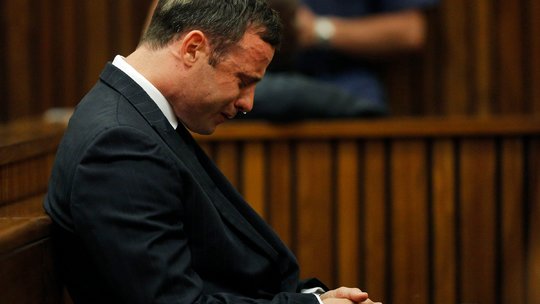
 In South Africa, Oscar Pistorius, the internationally known double-amputee Olympian on trial for murder and other charges in the Valentine’s Day shooting death of his model girlfriend Reeva Steenkamp, was found not guilty Thursday of premeditated murder, the most serious charge.
While ruling out the murder charge, judge Thokozile Masipa said she will consider culpable homicide and will announce the rest of her ruling Friday during the judgment phase, concluding the riveting trial that began in March.
Pistorius could still be sent to prison for a maximum of 15 years if convicted of culpable homicide or negligent killing, although five years is a guideline when a firearm is used. He faced 25 years to life in prison if he had been convicted of premeditated murder. He faced a minimum of 15 years if found guilty of murder without preplanning. Pistorius wept when the judge announced her ruling on murder.
The prosecution alleged that the athlete intentionally killed his girlfriend, a model and budding reality TV star, after a loud nighttime argument heard by neighbors. Masipa said there were “just not enough facts” to support the finding of premeditated murder or the lesser murder without preplanning.
“The accused cannot be found guilty of murder,” the judge said.
She said Pistorius acted negligently when he fired four times through a bathroom door in his home in the predawn hours of Valentine’s Day last year. In a moment of high drama, Masipa stopped reading out her verdict in the six-month trial and adjourned until Friday.
Because there is no trial by jury in South Africa, Masipa is expected to explain exactly why she and her two legal aides came to the decision they have before the judge issues the verdict.
“I am of the view that the accused acted too hastily and with excessive force,” Masipa said of Pistorius’ actions on the fatal night.
The world-famous athlete known as the “Blade Runner” has acknowledged firing the shots that hit Steenkamp in the head, arm and hip area with hollow-point bullets from his 9 mm pistol. He said he mistook her for an intruder and denied murdering her, but the judge said Pistorius still could have taken other actions, like calling the police or security at his housing estate.
“Did the accused fail to take steps he should have taken? Yes,” Masipa said. “He failed to take any steps to avoid the death.”
At the start of the judgment hearing, Masipa told Pistorius, 27, that he should remain seated on the bench while she read her findings out and until she asked him to stand for the verdict.
In her hours-long assessment of witness evidence, she called Pistorius a “very poor witness” who had lost his composure on the stand and was at times “evasive.” But Masipa emphasized that did not mean he was guilty of murder.
The 66-year-old judge also cast doubt on witness accounts of hearing a woman’s screams, a key part of the prosecution’s case. The defense had argued that it was Pistorius who was screaming in a high-pitched voice after discovering he had fatally shot Steenkamp.
Masipa cited testimony of an acoustics expert called by the defense, saying it cast serious doubt on whether witnesses who were hundreds of meters away in their homes — as some state witnesses were — could have differentiated between the screams of a man or a woman.
At one point, Masipa said: “I continue to explain why most witnesses got their facts wrong.”
Masipa said she was disregarding text messages between Steenkamp and Pistorius that had been entered as evidence. Prosecutors had submitted text messages that showed tension between the couple while the defense submitted messages that indicated mutual affection. That evidence, the judge said, doesn’t prove anything.
“Normal relationships are dynamic and unpredictable most of the time, while human beings are fickle,” she said.