 Though the national unemployment rate ticked up just slightly from June to July, going from 6.1 percent to 6.2 percent, a state-by-state view of the statistics reveals that the jobless rate rose in 30 states last month.
The numbers released Monday by the Labor Department show that the unemployment increases came even as employers in two-thirds of the states stepped up hiring.
The numbers likely mean that the more promising economy has encouraged more unemployed people to actively seek jobs, which results in an increase in the unemployment rate. The jobless aren’t listed as unemployed unless they are actively seeking work.
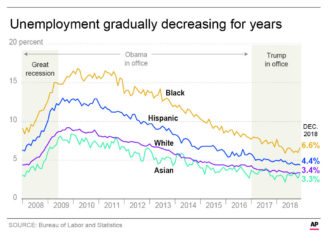
These numbers echo a report last month by the Federal Reserve showing that the long-term unemployment rate has finally begun a rapid fall, which is largely why the nation’s overall unemployment rate has been relatively low since the start of 2014.
But the Fed’s numbers indicated that the number of African-Americans who meet the definition of long-term unemployed — that is, out of work for at least six months — is still more than double the rate for the overall population.
The percentage of the workforce that is long-term unemployed is now 1.98 percent, which is less than half of the record high of 4.4 percent that it reached in 2010. The long-term unemployment rate for African-Americans is going down, too, currently standing at 5.1 percent. But that rate is still much higher than the 3.4 percent for whites in 2010, when everyone’s numbers were escalated during the Great Recession.
“The improvement in the labor market is reaching the long-term unemployed,” Heidi Shierholz, an economist at the Economic Policy Institute, told The New York Times at the time. “They are benefiting from the modest but measurable improvement in the labor market.”
The improvement in the long-term rate is largely responsible for the overall unemployment rate dropping down to the current level of 6.2 percent.
The news from the Labor Department on Monday indicated the unemployment rates fell in eight states in July and were unchanged in 12. In addition, according to The Associated Press, hiring rose in 36 states, fell in 13, and was unchanged in Iowa.
Among the states, Mississippi had the highest unemployment rate in July, at 8 percent. In July, Georgia had the second-highest rate at 7.8 percent, while Michigan, Rhode Island and Nevada were tied with the third-highest, 7.7 percent.
The lowest rate in the nation was in North Dakota, where the number was 2.8 percent. With the oil and gas drilling boom there, North Dakota has had the lowest rate for years.
Among states with big job gains, the biggest were in Texas, adding 46,600 jobs, followed by California at 27,700 and Michigan at 17,900.