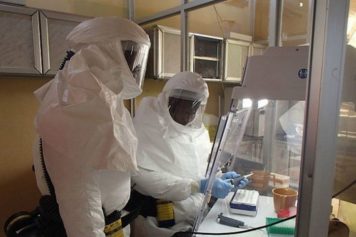
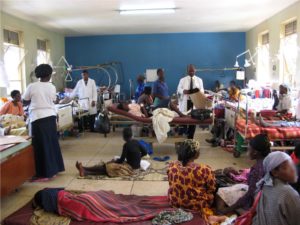
 The first American has died in the Ebola outbreak in West Africa.
Patrick Sawyer, whose wife and three children live in Coon Rapids, Minnesota, collapsed after getting off a plane in Lagos, Nigeria.
Sawyer was infected in Liberia, where he worked as a top government official in the Liberian Ministry of Finance. He was immediately taken to a local Nigerian hospital on July 20. He died five days later.
According to his wife, Decontee, he may have contracted the virus from his sister.
Born in Liberia, Patrick Sawyer and his wife are naturalized U.S. citizens. He had been planning to head back to the U.S. for two of his daughters’ birthdays in August. But now the family is planning his funeral.
“He was so proud when he became a U.S. citizen,” his wife told CNN. “He voted for the first time in the last U.S. presidential election. He lived in the U.S. for many years and wanted that for Liberia — a better democracy.”
This case is also the first one for Nigeria, as up until now the Ebola outbreak was contained to three West African countries, Liberia, Sierra Leone and Guinea.
This is as close to home as the epidemic has gotten, making some folks wonder if the deadliest Ebola outbreak on record could make its way to the United States.
Last week, two American aid workers in Liberia’s capital city, Monrovia, were confirmed to be infected and are currently battling the disease. NBC News reports that Nigerian authorities are monitoring 59 people, including airline workers, who came into contact with Sawyer.
In a news briefing Monday, the Centers for Disease Control and Prevention (CDC) said there was “no significant risk” in regards to a potential outbreak in the United States.
“The U.S. health care system is also better suited to handle an Ebola case than many in West Africa,” said Dr. Marty Cetron, director of CDC’s Division of Global Migration and Quarantine. “Health officials would likely recognize such a case and be able to trace all points of contact with the patient to prevent further transmission.”
“Epidemics of disease are often followed by epidemics of fear and epidemics of stigma. All of these things occur in a social context that can make containment very challenging.”
S.C. Rhyne is a blogger and novelist in New York City. Follow the author on Twitter @ReporterandGirl, http://Facebook.com/TheReporterandTheGirl and visit her website at http://www.TheReporterandTheGirl.com