The Beginning of Mass Enslavement of Africans
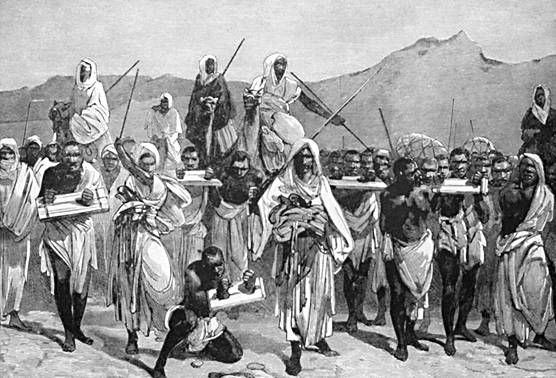
While slavery existed in various degrees throughout time, the unprecedented scale of trafficking Africans in a chattel slave trade began not with Portugal, but according to many well-respected scholars, with Arabs.
As Elikia M’bokolo, the renowned historian from the Democratic Republic of Congo, wrote in Le Monde diplomatique: “The African continent was bled of its human resources via all possible routes. At least ten centuries of slavery for the benefit of the Muslim countries (from the ninth to the nineteenth). … Four million enslaved people exported via the Red Sea, another four million … through the Swahili ports of the Indian Ocean, perhaps as many as nine million along the trans-Saharan caravan route, and eleven to twenty million (depending on the author) across the Atlantic Ocean.”
“Despite the long history of slavery in the Arab World and in other Muslim lands, little has been written about this tragedy,” writes Murray Gordon in the introduction of “Slavery in the Arab World.”
While Gordon acknowledges that at times the Islamic version of slavery could be more “humane” than the European colonial practice, he provides many facts that indicate that slavery under Muslims could be extremely cruel as well.
One particularly brutal practice was the mutilation of young African boys, sometimes no more than 9 or 10 years old, to create eunuchs, who brought a higher price in the slave markets of the Middle East. Slave traders often created “eunuch stations” along major African routes where the surgery was performed on the children in unsanitary conditions.
Slavery is still practiced today in two Islamic nations: The Sudan and Mauritania.