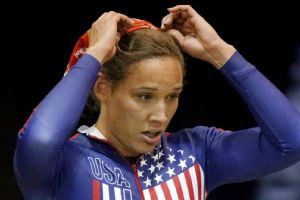
 Lolo Jones, the former U.S. Olympic track star, and Lauryn Williams, another superb track athlete, were used to crossing a finish line, taking deep breaths and peering up at a scoreboard to learn if they had made an Olympic team.
No wonder they were nervous Sunday night.
The U.S. Olympic Bobsled Team announcement was not so cut and dry. The athletes entered a room after a six-person committee deliberated, and they listened.
“After my name was called,” Jones said, “it was a deep sigh of relief.”
Both of their names were officially called around the stroke of midnight in Austria. Jones and Williams, with five Summer Olympics between them, were selected to their first Winter Olympic teams.
“The biggest honor I’ll ever have in my life is representing Team USA,” Jones said. “I’m overwhelmed with emotions.”
Jones, 31, hopes to reverse Olympic heartbreak in Sochi and win her first medal.
In 2008, she was favored to win the 100m hurdles and leading the final when she clipped the ninth of 10 hurdles and stumbled to seventh place. She cried alone in a hallway underneath the Beijing Olympic Stadium.
In 2012, she finished fourth in the 100m hurdles, one tenth of a second off the podium.
Jones picked up bobsledding shortly after the London Games at the urging of 2010 Olympic bronze medalist Elana Meyers. A quick learner, she finished the 2012-13 season as the No. 4 push athlete on the U.S. team.
“The bobsled process is definitely more stressful” than track and field, Jones said. “As a brakeman, there’s a lot of criteria and races. It’s not just one and done. it’s the course of a season.”
Williams, 30, learned that this year. She won Olympic gold in the 4x100m relay in London and silver in the 100m in Athens in 2004. Last summer, Jones planted the seed for Williams to convert at a track meet.
Williams, who went to the University of Miami, was well aware of the drawbacks, not the least of which was the climate change. She tried out and sprouted quickly, climbing the push athlete ladder faster than Jones had the year before.