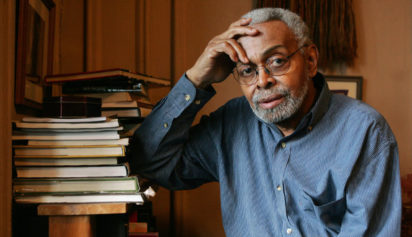
Amiri Baraka, the American revolutionary writer of poetry, drama, fiction, essays and music criticism, died Thursday at the Newark Beth Israel Medical Center, where he was hospitalized last December. He was 79.
At House of Nehesi Publishers (HNP) the passing of the great man, teacher, and friend saddens us tremendously. The confidence he showed in publishing two of his books in St. Martin with HNP continues to encourage us in our work and becomes part of his international legacy.
In the U.S., “he inspired generations of poets, playwrights and musicians, and his immersion in spoken word traditions and raw street language anticipated rap, hip-hop and slam poetry. The FBI feared him to the point of flattery, identifying Baraka as ‘the person who will probably emerge as the leader of the Pan-African movement in the United States,’” wrote america.aljazeera.com on Thursday, adding that he was “as controversial as he was admired.”
Baraka was born on Oct. 7, 1934, in Newark, N. J. The author of over 40 books of essays, poems, drama, and music history and criticism, Baraka was a poet icon and revolutionary political activist who lectured on cultural and political issues extensively in the U.S., the Caribbean, Africa and Europe.
With influences on his work ranging from musical orishas such as Ornette Coleman, John Coltrane, Theophilus Monk, and Sun Ra to the Cuban Revolution, Malcolm X and world revolutionary movements, Baraka is renown as the founder of the Black Arts Movement in Harlem in the 1960s that became, though short-lived, the virtual blueprint for a new American theater aesthetics.
The movement and his published and performance work, such as the signature study on African-American music, Blues People (1963) and the play Dutchman (1963) practically seeded “the cultural corollary to Black nationalism” of that revolutionary American milieu. Baraka would endure as “a major political, cultural and academic figure for more than five decades,” said Trinidadian economist David Abdulah, upon hearing of his death.
Other titles range from Selected Poetry of Amiri Baraka/LeRoi Jones (1979), to The Music (1987), a fascinating collection of poems and monographs on jazz and blues authored by Baraka and his wife and poet Amina, and his boldly sortied essays, The Essence of Reparations (2003), and Razor (2011).
Published in St. Martin, The Essence of Reparations is Baraka’s first collection of essays in book form radically exploring what is sure to become a 21st century watershed movement of Black people to the interrelated issues of racism, national oppression, colonialism, neo-colonialism, self-determination and national and human liberation, which he has long been addressing creatively and critically. It has been said that Baraka is committed to social justice like no other American writer. He has taught at Yale, Columbia, and the State University of New York at Stony Brook.
Baraka’s most controversial works in recent years include the poem “Somebody Blew Up America,” which appears in Somebody Blew Up America & Other Poems, his first poetry book published in the Caribbean.
According to another great man of letters, Kamau Brathwaite, “The publication of Amiri Baraka’s Somebody Blew Up America & Other Poems makes one more mark in the development in modern Black radical and revolutionary cultural reconstruction.” The title poem actually headlined Baraka in the media in ways rare to poets and authors.
The recital of the poem “that mattered” engaged the poet warrior in a battle royal with the governor of New Jersey and a legion of detractors demanding his resignation as the state’s poet laureate because “Somebody Blew Up America’s” provocatively inquired – in a few lines of the poem – who knew beforehand about the New York City World Trade Center bombings in 2001. The poem’s own detonation caused the author’s photo and words to be splashed across the pages of New York’s Amsterdam News and The New York Times and to be featured on CNN – to name a few U.S. national and international media.
Baraka lived in Newark with his wife and author Amina, and their children. The couple had also headed up the word-music ensemble, Blue Ark: The Word Ship, and co-directed Kimako’s Blues People, the ‘artspace’ housed in their theater basement for some fifteen years.
His awards and honors include an Obie, the American Academy of Arts and Letters award, the James Weldon Johnson Medal for contributions to the arts, Rockefeller Foundation and National Endowment for the Arts grants, professor emeritus at the State University of New York at Stony Brook, an African Diaspora Youth Development Foundation plaque, and poet laureate of New Jersey.
-By Lasana M. Sekou