The military-backed interim Egyptian government has declared the Muslim Brotherhood a terrorist group after blaming it for a deadly attack on a police headquarters earlier this week.
Hossam Issa, the interim minister of higher education and a deputy prime minister, announced the Cabinet’s decision on state-run al-Masriaya television.
“The government reiterates that there will be no return to the past under any circumstances and Egypt, the state and the people, will never succumb to the terrorism of the Muslim Brotherhood whose crimes have gone far beyond all moral, religious and human limits,” he said.
Egypt’s leaders have been in conflict with the movement since July, when the military deposed President Mohamed Morsi, Egypt’s first democratically elected president and a former Brotherhood leader. State forces have killed hundreds of the group’s supporters during protests against Morsi’s removal. Most of its leaders and thousands of its members have been imprisoned, says Kareem Fahim writing for the New York Times.
Banned
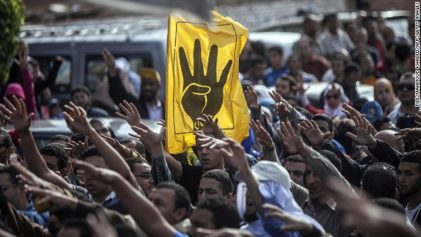
According to the BBC, “Brotherhood supporters have staged protests since Mr. Morsi’s government – the first to be democratically elected in Egypt – was toppled on 3 July following widespread anti-Brotherhood demonstrations.
The 85-year-old Islamist movement was banned by Egypt’s military rulers in 1954, but registered as an NGO called the Muslim Brotherhood Association in March this year in response to a court case bought by opponents who contested its legal status.
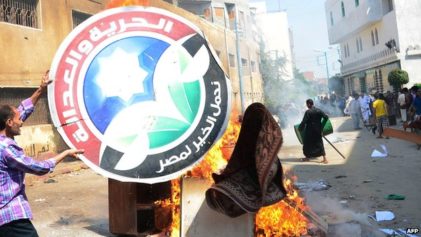
The Brotherhood also has a political wing, the Freedom and Justice Party (FJP), which was set up in 2011 as a “non-theocratic” group after the uprising that forced President Hosni Mubarak from power.
Following Mr. Morsi’s overthrow and the suspension of the Islamist-friendly 2012 constitution, the Cairo Administrative Court and the Social Solidarity Ministry were tasked with reviewing the Brotherhood’s legal status, the BBC reported.
In September, a ruling by the Cairo Court for Urgent Matters banned the Brotherhood itself, the NGO, as well as “any institution derived from or belonging to the Brotherhood” or “receiving financial support from it.”